
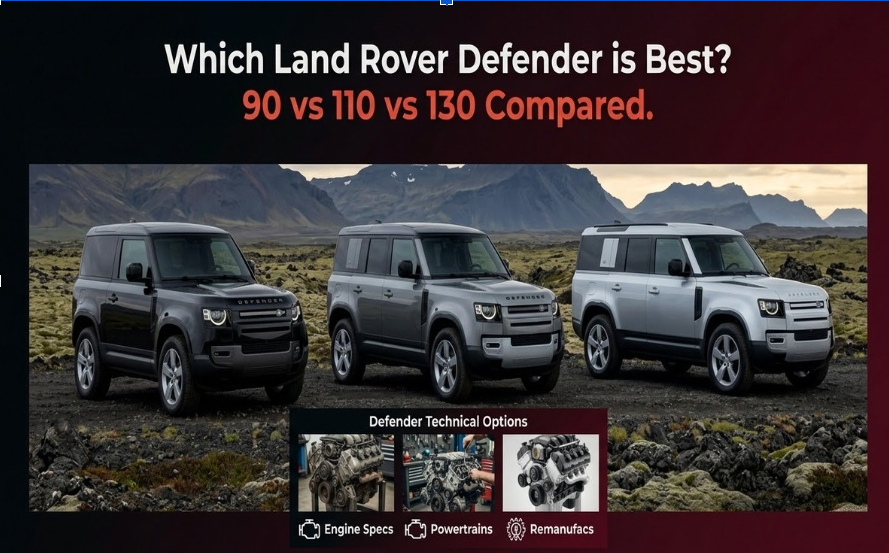
Which Land Rover Defender is best depends on what one needs from the vehicle. The 110 D300 in X-Dynamic HSE trim is the best choice for most customers.
However, it is not the right answer for you if you need 8 seats, don’t like the current generation’s price tag or want something with a different value.
This guide provides a straight answer for every type of buyer, explains the most important engine choice people agonise over for longer than they should, and identifies which versions to avoid.
The Body Style Decision First:
The body style is the first thing that will determine if the Defender fits into your life or not before the engines or trim levels.
Defender 90 vs 110 is the most common split among buyers. The 90 is a shorter, two-door and really tough to live with as an all-in-one vehicle. It’s a pain on day three, and it’s a pain on day 300, to get kids in and out of rear seats that require a front seat to be tilted forward.
The 90 is a more popular choice for many, is marginally more agile in urban environments and is approximately £7,000 cheaper. It’s a good idea if you’re looking for a second car or one you use mostly for special occasions. The 110 is the logical choice for a family’s sole vehicle.
The Land Rover Defender 110 review from owners who have driven a lot of miles is unanimous: five doors, rear seats that can be accessed and a boot that is usable is the version that should be purchased.
The interior is decent for the price; the off-road performance is greater than most owners will ever need, and it can tow up to 3,500kg without a complaint.
Defender 130 vs 110 is a more obvious choice than 90 vs 110. The 130 is the only choice if you require 8 seats on a regular basis. For those who require 7 seats on occasion, a 110 with the optional third row will do the job at £20,000 less. The 130 at 5,358mm long is indeed a challenge to park in the city. Those who drive the 130 and then mostly in the cities regret it.
The Engine Decision:
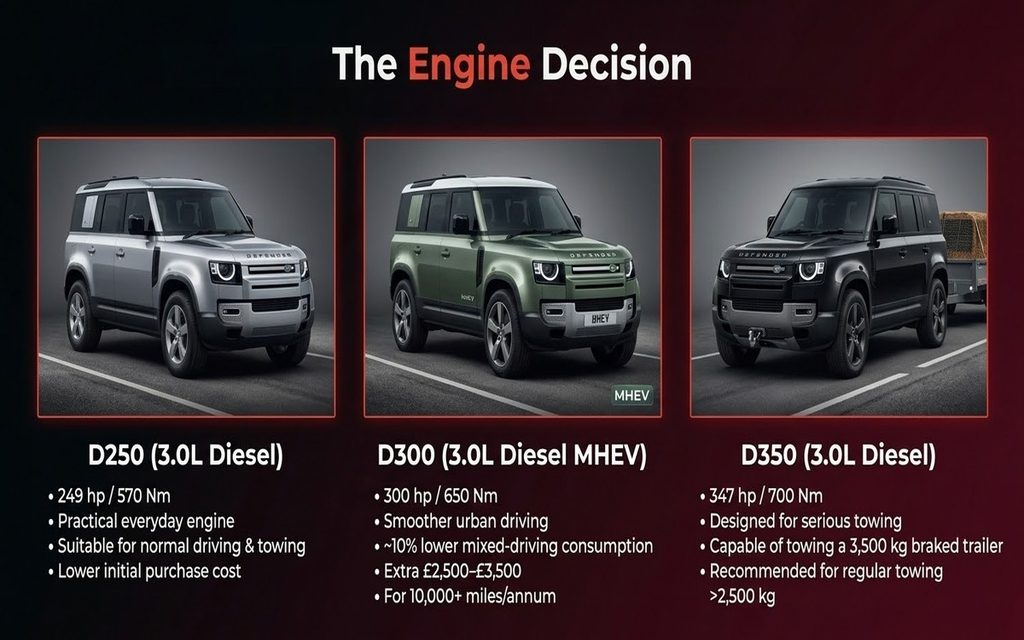
For most buyers, the D300 is the best Defender engine.
The D250 3.0-litre diesel’s 249hp is sufficient for the tasks the Defender is expected to perform, including towing. It’s cheaper in the beginning.
The Land Rover Defender D300 is a 300 hp mild hybrid, making town driving smoother and fuel consumption about 10% lower in mixed driving. The D300 is a worthwhile extra £2,500 to £3,500 on the price tag for anyone who drives over 10,000 miles annually.
The D350 is the towing engine. It is capable of towing a 3,500kg braked trailer with 347hp and 700Nm of torque, which is less than the D250 or D300. Pay the D350 if you tow regularly over 2,500kg. The D300 is suitable for occasional, light towing.
The P300e PHEV has a 31-mile electric range, meaning that it can complete the majority of urban commutes without the petrol engine. If you charge regularly, the PHEV is a good value for Defender buyers who spend half their time in city areas and half out of them.
For most buyers, who drive primarily on motorways and country roads, it is simply extra weight and complexity for a feature that they will rarely use.
The Trim Level Verdict:
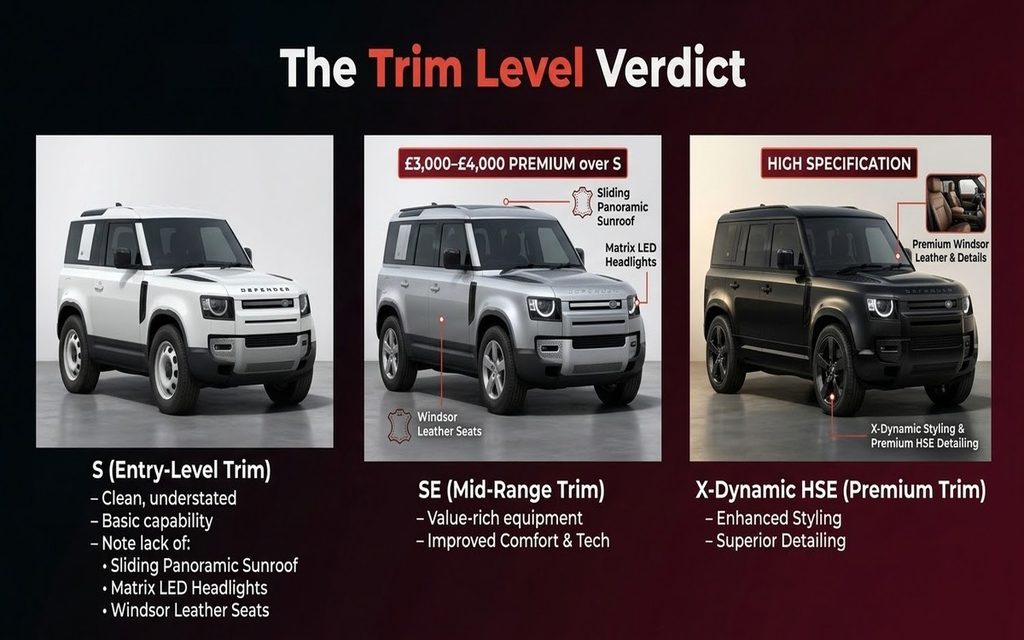
In the majority of cases, the X-Dynamic HSE is the best Land Rover Defender to buy on trim.
The S is the entry-level model, and it does away with enhancements that make the car easier to use: the sliding panoramic sunroof, Matrix LED headlights and Windsor leather seats really make a difference to the ownership experience. The premium for SE over S is £3,000–£4,000 and is worth it.
The X features 22-inch diamond-cut wheels, enhanced leather seats and heated/cooled seats. The HSE is about £5,000 – £7,000 cheaper depending on body style.
The 22″ wheels compromise rideability a bit on poor surfaces and are more expensive to replace. If the specification is not really important to you, then the HSE is where the value is.
Classic Defender Vs New Defender:
For buyers who have £25,000 to £45,000 to invest, it’s a real choice between Classic Defender vs new Defender.
A 2014–2016 Defender 110 2.2 TDCi XS in good condition with documented history costs £28,000–£42,000, the same as a decent used L663 110 SE.
The classic has greater value stability over time (late classic XS examples have not lost value since the end of production), a more straightforward mechanical platform and a character that the L663 intentionally mentions but can’t duplicate.
The L663 also has improved fuel economy, increased safety electronics, a much more refined interior and much more off-road electronics.
The choice between the Classic Defender vs new Defender is all about ownership. The classic is harder to live with, easier to maintain at an independent specialist, and is becoming scarce. The L663 depreciates more each year for the first 4 years but is easier to own every day.
Which Defender To Avoid:
Which Defender to avoid as used purchases: The 2020 and early 2021 L663 models were known to have more build quality problems than later models.
The first year of production has more electrical faults, infotainment glitches and panel fit issues. The examples for 2022 onwards are better constructed.
Which Defender to avoid in classic: Any Defender 110 that has been extensively modified without documentation. Lifted suspension, engine swaps and converted interiors all have an impact on insurability, finance eligibility and resale.
The original specification standard late TD5 or 2.4 TDCi is more valuable and less expensive to insure than the same car lifted 3 inches and equipped with a non-standard engine.
Is the OCTA Worth It?
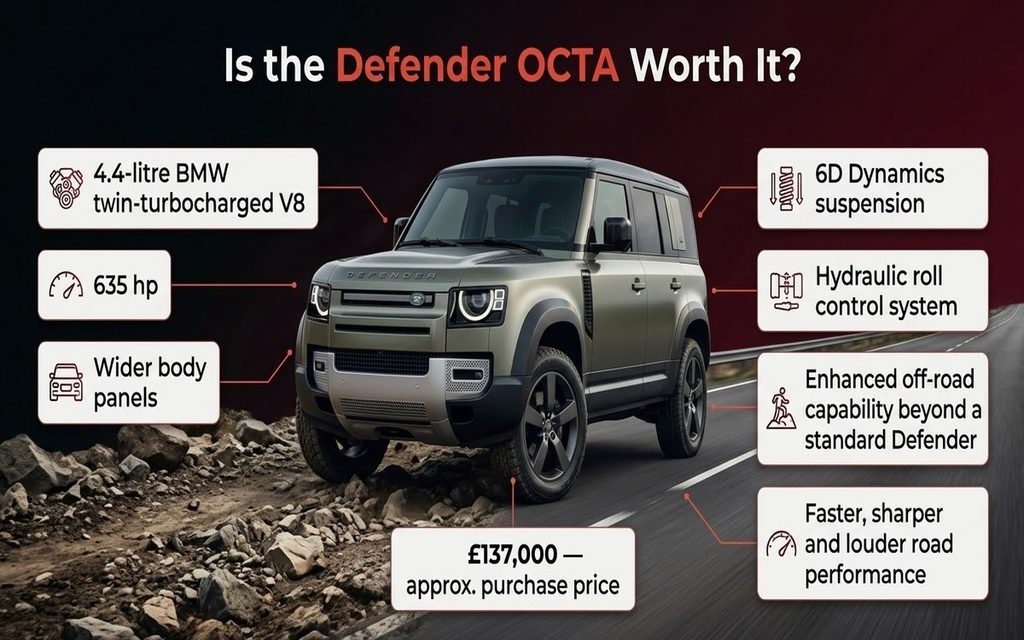
Whether or not the Land Rover Defender OCTA worth it, at the rate of £137,000, is entirely dependent on what you want to do with the money.
It’s powered by a 4.4-litre BMW twin-turbocharged V8 delivering 635 hp, features 6D Dynamics suspension, wider body panels and a hydraulic roll control system. It can do things a standard Defender can’t off-road. On-road, it is faster, sharper and louder than any Defender ever.
Land Rover Defender OCTA worth it as a performance SUV purchase? Yes, if you’re looking for the ultimate version of this nameplate, and you’re looking for a performance SUV.
No. 1 is a practical Defender buy at over double the price of a D350 X.
The Defender 110 For Families: Honest Assessment
Defender 110 for families is a truly decent option, except for one thing. The back seats are spacious and comfortable for adults.
Boot space with all seats up is 397 litres, which is not large for a vehicle of this size. The third row is also optional, which further decreases boot space when used.
Defender 110 for families is good for two adults and two children and occasional weekend packing. It’s not as effective for large families that require frequent access to boot space and 6 or 7 seats. In that case, the 130 is the right choice even though it is longer.
FAQs:
Which Land Rover Defender is the best overall?
The 110 D300 in X-Dynamic HSE trim is the most popular Land Rover Defender for most buyers. It’s got the right engine for economy and performance, the most usable body size for families and the specification level at which daily-use features are available without the premium of the X trim.
Which is the best used Land Rover Defender to purchase?
The best Land Rover Defender to buy used is a 2022-onwards 110 D300 X-Dynamic HSE with less than 30,000 miles or a 2014-2016 2.2 TDCi 110 XS with a documented history for those who prefer a classic.
Which is the best Defender 90 or 110?
Defender 90 vs 110: the 110 is more suitable for everyday use. The 90 is better as a second car or if the shorter proportions of the 2-door is what you’re looking for.
Which is the best Defender engine?
The D300 3.0-litre mild hybrid diesel is the best Defender engine for most buyers. For those who tow regularly in excess of 2,500kg, the D350 is the option. The PHEV is designed for urban drivers who plug in every day.
Should the Land Rover Defender 130 be purchased instead of the 110?
Defender 130 vs 110: worth it only if you really need 8 seats on a regular basis. The 130 is too long to be used comfortably in urban settings and is much more expensive. The 110 optional third-row seats are the better option for 7 occasional seats.
Conclusion:
For most buyers, the answer is obvious when it comes to which Land Rover Defender is best: the 110 D300 HSE. The 90 is for those who want the style and don’t mind the compromise. The 130 is for those looking for space.
The OCTA is for buyers who are looking for the most extreme version, no matter the cost. The classic is for buyers who prefer character and value stability over refinement.
If you are looking for a Jaguar and Land Rover Engine Rebuild or Repair, Diagnostic Expertise and Maintenance or a Tune-up on any Defender variant, contact Jaguar and Land Rover Engine Specialists at jaguarlandroverengines.co.uk or call 02081241303.