

How reliable is the Land Rover Defender depends on which generation you own, which engine it has and whether “reliable” means never breaking down or being fixable when it does.
The figures are not good. In 2024, Carbuyer found 40.6% of Land Rover owners experienced a fault in the first year of ownership. That’s the brand, not just the Defender, but the Defender makes a contribution to that.
Those numbers don’t tell you about a software glitch on a new L663, or a mechanical failure that leaves you stranded. This is not the same ownership experience as the two.
What The Reliability Surveys Actually Show:
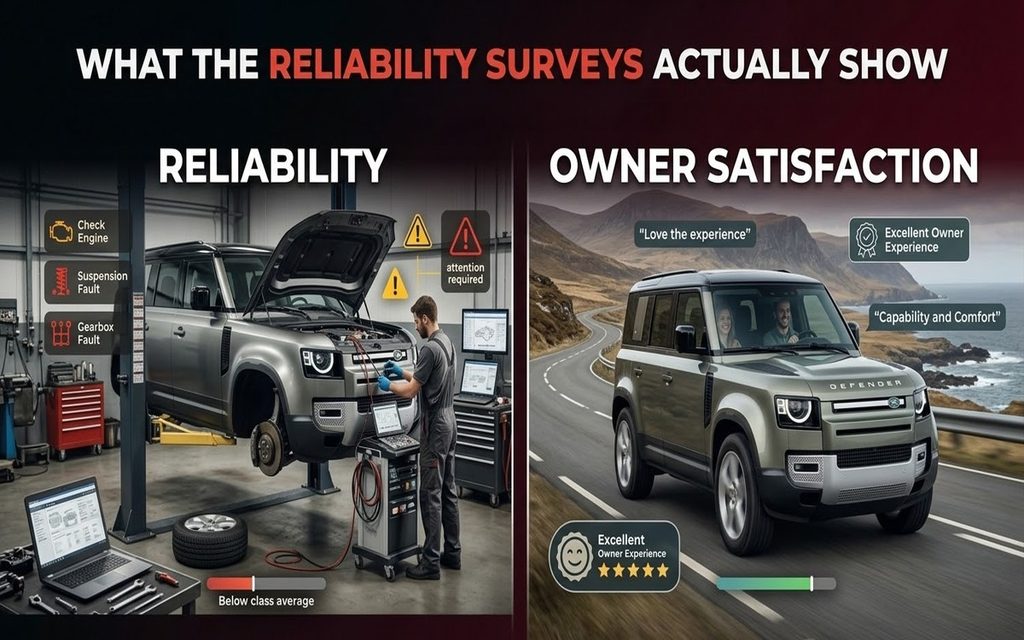
In independent tests, Land Rover Defender reliability ratings are consistently lower than the class average for large SUVs.
The Land Rover’s reliability index, the Driver Power 2024 brand survey and RAC owner data all agree: Land Rover is not doing well compared to Toyota, Lexus and Porsche when it comes to fault frequency, but it is doing well when it comes to owner satisfaction scores.
Despite the fault rate, Land Rover came out on top of the 2024 Driver Power brand satisfaction survey, finishing 10th.
The seeming paradox has a simple explanation. The owners of Defenders are familiar with what they are purchasing. They’re willing to take some risk for minor flaws in return for capability, character, and a vehicle that no direct competitor can match.
The reliability issue with the Land Rover Defender is not the same as when you have a vehicle that you don’t regret owning.
L663 Vs Classic Defender: Two Different Reliability Profiles
Land Rover Defender L663 reliability and classic Defender reliability (pre-2016 models) are two different things.
The mechanical platform of the classic Defender is simple and was built up to 2016. The 2.4 TDCi and 2.2 TDCi engines are powerful and have well-understood and manageable maintenance needs.
The main long-term issues are not mechanical engine failure, but body corrosion and wiring loom degradation. In practical terms, a classic Defender 110 with a known history of service and a recent chassis inspection is a reliable vehicle.
The 2020 L663 is a completely new car. It is powered by 48-volt mild hybrid electronics, an all-aluminium body structure, air suspension, Terrain Response 2 and more than 100 electronic control modules. Its fault rate is due to its complexity.
The fault rates for early 2020 and 2021 production models were higher than for 2022 onwards examples. Most of the reported problems were related to infotainment glitches, air suspension warnings, software problems that caused false warning lights and camera system problems. The number of mechanical failures was lower than the fault-rate figures indicated.
Reliability By Engine:
Defender engine reliability varies between the available powertrains.
| Engine | Type | Reliability assessment |
| D250 3.0-litre diesel | 6-cylinder Ingenium | Generally strong, known DPF issue on short-trip drivers |
| D300 3.0-litre diesel MHEV | 6-cylinder Ingenium + 48V | Good; MHEV system adds minor additional complexity |
| D350 3.0-litre diesel MHEV | 6-cylinder Ingenium + 48V | As D300, higher turbo load at full towing capacity |
| P300e PHEV | 2.0-litre petrol + electric | More components to fail, higher fault rate than diesel |
| P400 3.0-litre petrol | 6-cylinder Ingenium | Low UK fault data, less common in UK fleet |
| P525 5.0-litre V8 | Supercharged AJ133 | Reliable engine, costly to repair when faults occur |
The Defender D300 reliability is the best of the Ingenium diesel variants in UK ownership data. The mild hybrid system helps to save fuel in town and offloads the engine at lower speeds. Timing chain problems reported on the 2.0 Ingenium diesel (204DTA) in smaller JLR cars are not a major problem on the 3.0 six-cylinder Ingenium in the D250, D300 and D350.
The Defender PHEV reliability story is not as clear-cut. The P300e is an already complicated vehicle with the addition of a battery pack, electric motor, second inverter and extra cooling circuits.
Owners experience more electrical issues with PHEV examples than with similar diesel models. The PHEV is still cost-effective for buyers who charge regularly and drive in urban areas. The complexity is a risk for buyers who charge infrequently and drive primarily on motorways, where fuel savings are not as great.
The Air Suspension Question:
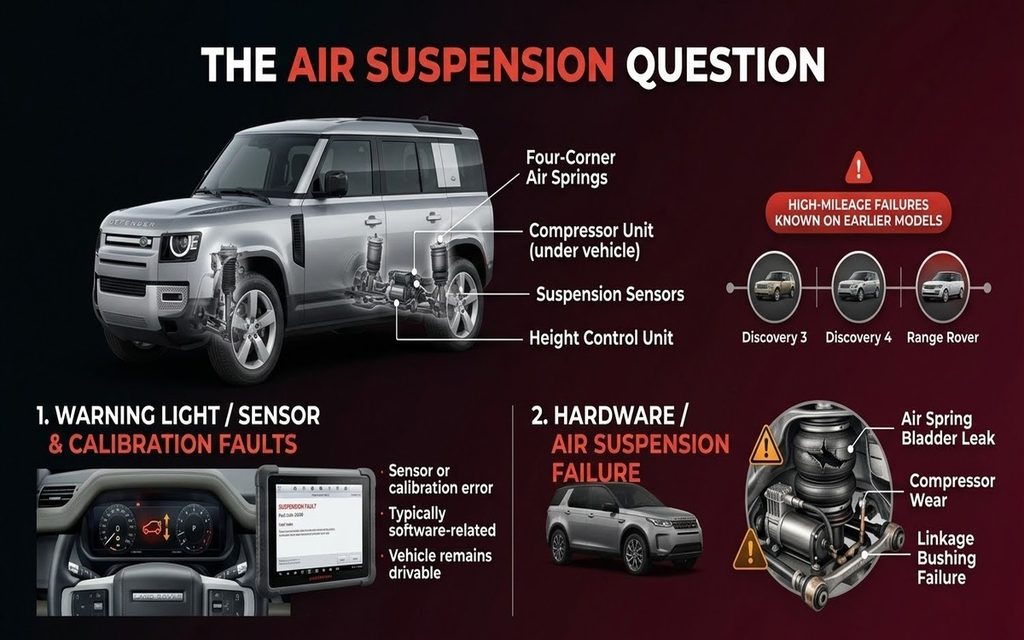
Air suspension is the focus of more Defender 110 reliability questions than any other system.
The L663 Defender is air suspension all the way. The air suspension system on JLR cars has been known to fail on high-mileage Discovery 3, 4 and Range Rover models. The L663 is a newer generation system, and the early failure rates of the older JLR platforms have not been seen at the same rate on the Defender to date.
There are two types of air suspension faults on the Defender L663. Warning lights are caused by sensor or calibration errors, and the car is still drivable; typically, these are software fixes.
L663 is less likely to experience compressor or air bag failure, but if it does, it can be costly. The cost of replacing the front air spring on a Defender 110 is £600 to £1200 at an independent JLR specialist. The same job at a main dealer costs £1,200–£2,200.
Owners who do a lot of driving in rural areas will sometimes buy a traditional spring conversion kit as a precaution, putting up with a slight compromise in refinement on the road for the £40 cost of a spring failure versus the £1,200 cost of an air bag.
How Service Interval Affects Defender Reliability?
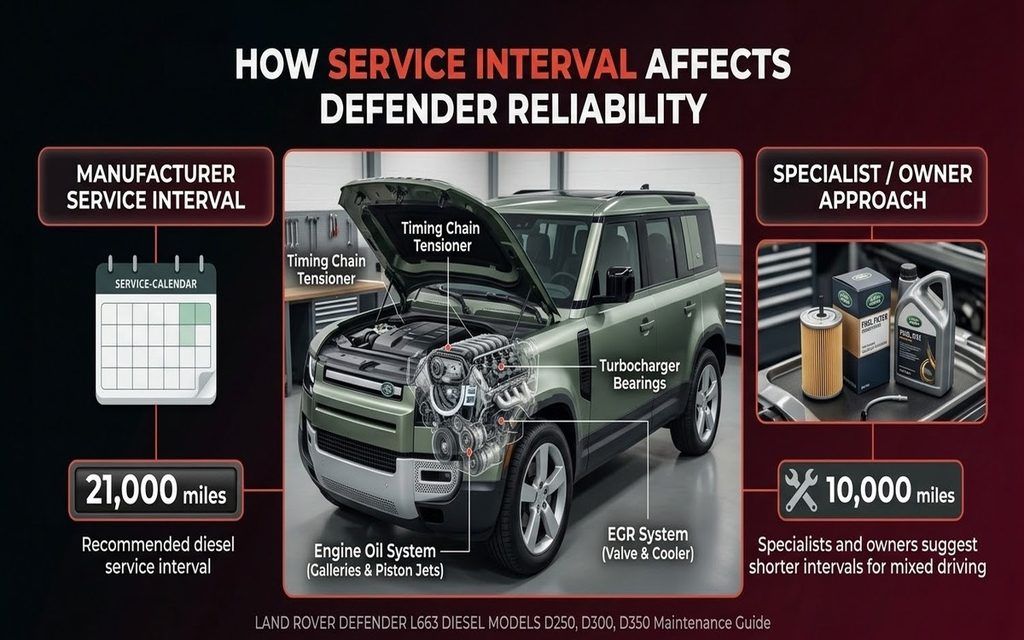
Defender service reliability is directly affected by oil change interval.
Defender diesel models have a service interval of 21,000 miles as recommended by the manufacturer. JLR specialists and independent Defender owners have always suggested that this should be reduced to 10,000 miles for mixed routes.
Ingenium 3.0-litre diesel in D250, D300 and D350 Defenders is a strong engine for its service life. Longer clearances cause oil degradation, which can lead to increased wear in the timing chain tensioner, turbocharger bearings and EGR (Exhaust Gas Recirculation) system.
The owners who report the lowest number of mechanical issues on L663 Defenders are those who change oil every 10,000 miles, perform annual diagnostic checks using SDD (Symptom-Driven Diagnostics) software and promptly download software updates through authorised channels.
Defender Vs Its Rivals On Reliability:
Comparing Land Rover Defender vs Toyota Land Cruiser reliability is a fair comparison. The Land Cruiser 300 has been proven to have a much lower fault rate than the Defender. Toyota has been ahead of Land Rover in reliability tests at Motorway since they began.
The Land Cruiser also holds its value and has lower annual repair costs over 5 years of ownership.
In the UK, the Defender outsells the Land Cruiser. Buyers know about the reliability comparison and take it. Despite the reliability surveys, the off-road electronics package, the interior quality and the kerb presence of the Defender 110 are not replicated in the eyes of UK buyers.
Ineos Grenadier vs Defender reliability is a comparison newer Defender buyers now make. The Grenadier is powered by a petrol or diesel engine sourced from BMW, a ZF 8-speed gearbox and a more stripped-back set-up than the Defender.
Initial reliability experience with the Grenadier is good. It’s not yet a known quantity of more than 100,000 miles, but its mechanical simplicity is a true selling point for those who’ve been disappointed with Defender electronic issues.
FAQs:
Is the Land Rover Defender L663 reliable?
The Land Rover Defender L663 has a higher number of documented faults than the 2022 onwards models. How reliable is the L663? The majority of faults are not mechanical, but electrical or software-related. The D300 diesel is the most reliable powertrain in UK data.
Which Defender is more likely to be reliable, the old one or the new one?
Assessing the reliability of Land Rover Defenders from the classic era (pre-2016) is easier. The 2.4 and 2.2 TDCi engines are mechanically sound. Electronics are minimal. The Classic Defenders are more prone to corrosion and wiring loom degradation, but less susceptible to failure than the L663.
Which Defender engine is the most reliable?
The D300 3.0-litre mild hybrid diesel comes out on top of the reliability numbers for the Defender. The 6-cylinder Ingenium 3.0-litre engine is not known to suffer from the timing chain issues found in the 4-cylinder 2.0-litre engine in smaller JLR cars.
Does the Defender air suspension fail often?
Older JLR platforms are more prone to air suspension faults. This is a newer generation of the L663 Defender system. Failure of the warning lights is a common occurrence, while failure of the compressor and air bags is less common. If there is a physical failure, expect to pay £600 – £1,200 per corner.
Can you rely on the Land Rover Defender for everyday driving?
For most owners, Land Rover Defender reliability for everyday driving is sufficient, especially for models from 2022 and later that come equipped with the D300 or D250 diesel engine and 10,000-mile oil change intervals. It demands more attention than a Toyota Land Cruiser and is more expensive to fix when it has problems.
Conclusion:
How reliable is the Land Rover Defender has a straight answer: it’s better than its reputation on mechanical reliability, but not as good as its competitors on fault frequency, and easily managed with proper service intervals and timely responses to warning lights.
The ones that have the most trouble are the owners who purchase them expecting Toyota simplicity. The owners who have the easiest time are those who make the 10,000-mile oil change, annual SDD diagnostic check and software updates a no-brainer.
To book Diagnostic Expertise, Engine Rebuilds and Repairs, and Maintenance and Tune-ups for any Defender variant, please visit jaguarlandroverengines.co.uk or call 02081241303.