
Knowing how to choose the right engine replacement for your Land Rover comes down to 4 main decisions: engine type, compatibility with your chassis, and overall budget, including labour and warranty conditions.
The 4 Land Rover engine options are: used, reconditioned, rebuilt, and remanufactured, costing between £1,800 and £9,500 each on the engine unit alone.
This engine replacement guide discusses all the alternatives with precise prices, what each of them provides, and how to prevent the most common mistakes made by Land Rover owners when changing an engine.
4 Land Rover Engine Replacement Options:
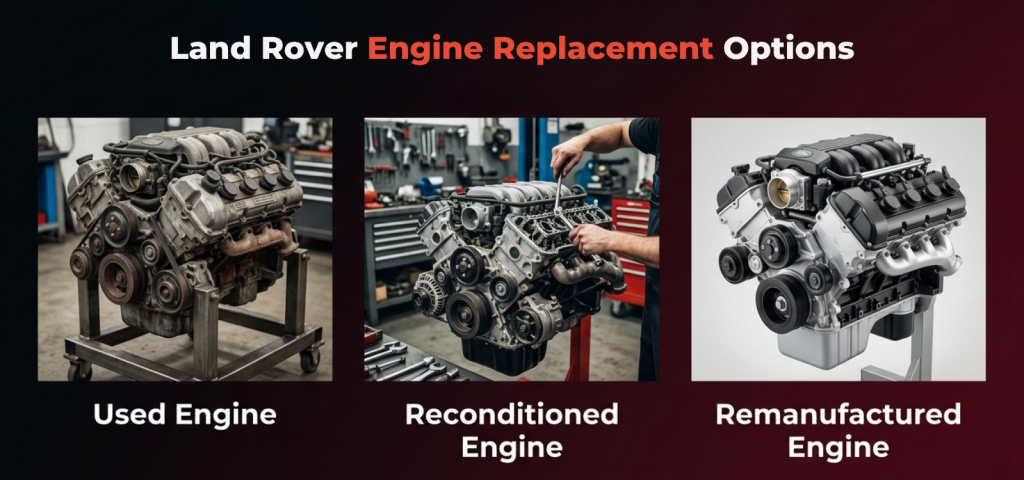
Used Engines:
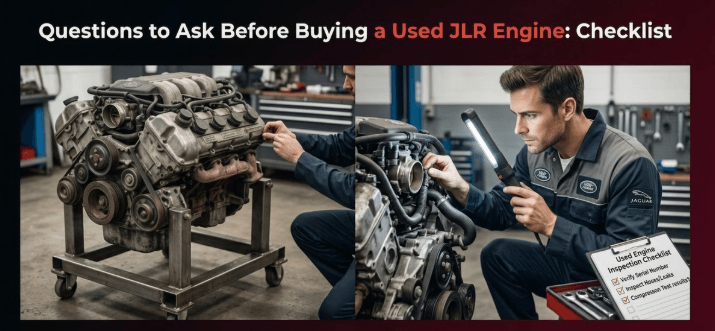
A used engine will cost between £1,800 and £3,500 and will be a low-mileage pull-out of a UK-sourced car. Before dispatch, reputable suppliers include a compression test report and an SDD (Symptom-Driven Diagnostics) health check. Warranty is 30 days to 6 months, based on the supplier.
Older Land Rovers like Series models, early Defender, or Discovery 2 owners are the best candidates for used engines because the vehicle value is not worth a complete reconditioned engine. Get the SDD report in writing before committing.
Reconditioned Engines:
A reconditioned engine is between £2500 and £5500 and is the best engine for Land Rover among the Discovery 3, Discovery 4, and Freelander 2 owners. The engine is disassembled, cleaned, and reassembled with OEM (Original Equipment Manufacturer) quality parts; new bearings, new piston rings, and seals are standard. Warranty covers 6 to 12 months.
In the case of the 3.0 TDV6 (engine code 306DT or 30DDTX), a quality reconditioned unit has a new timing chain tensioner (LR part LR029351) and a new oil feed.
Rebuilt Engines:
Rebuild engines cost between £3,000 and £6,500 and are appropriate for Range Rover Sport, Defender, and Discovery Sport owners who require OEM-like longevity. Rebuilding includes machining the block, changing the timing chain assembly, changing the high-pressure fuel pump (HPFP, LR part LR064285 on Ingenium units), and recalibrating the DPF (Diesel Particulate Filter); all are a part of this process.
Warranty lasts 12 to 24 months. In the case of the 5.0L AJ-V8 supercharged, a complete rebuild would involve new cam followers and lash adjusters, the 2 parts that break most frequently on high-mileage V8s.
Remanufactured Engines:
A remanufactured engine is priced between £4,500 and £9,500 and consists of a complete teardown to bare block, reassembled to the Land Rover Group specification. All internal parts are either machined or replaced to factory specifications. Warranty runs up to 24 months.
Remanufactured units are the right choice for supercharged V8 models, P400 Ingenium inline-6 units, and SDV8 owners who want to retain the vehicle in the long run. The initial high price is always cheaper than a second replacement in 3 years.
5 Factors That Determine the Right Engine Replacement for Your Land Rover:
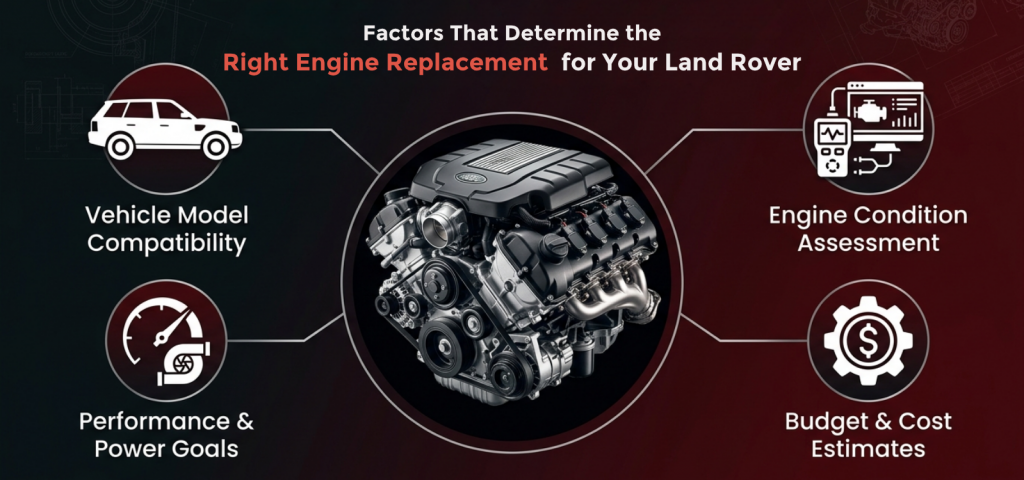
Engine Code And Chassis Compatibility:
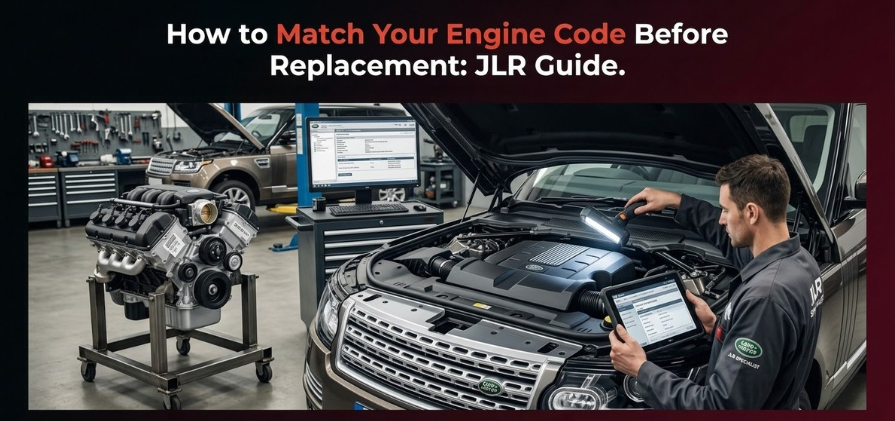
Find the engine code on the plate beneath the bonnet or cross-reference VIN 10 (model year) and 7 (engine variant). Check the chassis code L319 (Discovery 3/4), L322 (Range Rover Mk3), L405 (Range Rover Mk4), L460 (Defender current gen), since ancillary compatibility is completely dependent on this.
Combinations of a pre-2017 TDV6 (M57-derived) with a post-2017 Ingenium-based unit result in wiring-harness and engine-mounting incompatibilities. The engines have no connectors, and the ECU (Engine Control Unit) is not able to communicate between generations without a complete custom wiring conversion.
Diesel Or Petrol:
TDV6 and SDV6 diesel engines experience cracks in EGR (Exhaust Gas Recirculation) coolers. This is a known fault covered by Land Rover TSB T075/19. Reconditioned units should have improved aluminium-core EGR coolers, and not the original units.
Carbon accumulation on direct injectors occurs after 50,000 miles (80,000 km) on Ingenium petrol engines (P300, P400). Rebuilt Ingenium petrol units should include walnut-blasted cylinder heads to remove carbon deposits before installation.
The issue of ULEZ (Ultra Low Emission Zone) compliance is relevant to the owners in London. The exception is only Euro 6d-temp engines manufactured in 2020 and above, which are not subject to the charge of £12.50 daily.
Total Cost Including Labour:
The engine price is not the total cost. Labour, fluids, ancillary parts, and ECU coding are also significant additions.
Here’s an engine cost comparison:
| Type of Engine | Total Costs |
| Used Engine | £2,500–£5,000 |
| Reconditioned Engine | £3,500-7,500 |
| Rebuilt Engine | £5,000–£12,000+ |
The lowest initial cost is not necessarily the lowest cost in the long term. A 30-day warranty used engine that fails after 45 days costs the entire labour charge. A refurbished unit that has a 12-month warranty on the same failure costs nothing.
Warranty Terms:
Sign nothing without reading the warranty document. Quality suppliers cover all essential parts like timing chain tensioner, crankshaft bearings, and cylinder head gaskets. Do not accept warranties that cover the block only and not the known points of failure.
Length of warranty by engine type:
| Engine Type | Warranty |
| Used | 30 days to 6 months |
| Reconditioned | 6 to 12 months |
| Rebuilt | 12 to 24 months |
| Remanufactured | Up to 24 months |
Supplier Credentials:
A reputable supplier of Land Rover engines applies JLR diagnostics before and after testing, either SDD or Pathfinder. Before committing to any supplier, ask 3 questions:
- Does the compression test result include a written confirmation of at least 22 bar with no more than 1.5 bar difference between cylinders?
- Does it include a dyno run report of the oil pressure, idle stability, and emissions?
- Is the turbo actuator up to date with the LR specification?
OEM vs Aftermarket Engines: What Works on Land Rover Engine Replacements
OEM components are identical to the Land Rover factory specifications. The components that Land Rover engineers designed the engine around are Victor Reinz or Elring gaskets, Bosch injection pumps, and Mann oil filters. Aftermarket options are 20%-40% cheaper but have a wide range of quality.
In the case of internal engine parts, timing chains, head gaskets, turbochargers, and crankshaft bearings, there is no safe option other than OEM parts. Failure of a timing chain due to a low-quality aftermarket tensioner results in disastrous engine damage. The saving of £80 on a chain tensioner is insignificant compared to the cost of replacing the engine, costing £4,000.
Peripheral components such as air filters, sensor connectors, coolant hoses, and auxiliary belts can use aftermarket parts because the risk of failure is less and the replacement is easy. The most frequent Land Rover engine replacement OEM part references: TDV6 tensioner LR#LR029351, SDV8 oil pump LR#LR042997, Ingenium HPFP LR#LR064285.
Common Mistakes To Avoid:
- Selecting an engine without verifying the chassis code, a mismatched chassis will result in incompatible mounts, wiring, and ancillaries, and a £4000 purchase will become a £4000 error.
- Disregarding ECU compatibility, a replacement engine of a different generation will need complete ECU reprogramming; the engine will not communicate with Terrain Response, the gearbox, or the DPF system.
- Purchasing without a compression report, there is no written compression test result, so there is no evidence that the engine is working; avoid any supplier that cannot supply a compression test result.
- Paying twice to go for a second-hand engine with a 30-day warranty that stops working at 45 days costs the entire labour cost again; the cheapest now is always the most expensive in the long run.
Why Working with Jaguar Land Rover Engine Specialist is the Right Choice:
A replacement of an engine in a Land Rover by a general garage and that of a certified engine supplier in JLR gives different outcomes, and it shows within the first 10,000 miles.
Before removal, the specialists at Jaguar Land Rover Engine Specialist perform SDD or Pathfinder diagnostics to detect secondary faults, injector wear, turbo actuator condition, and EGR valve state, which a general workshop does not.
Repairing the engine without correcting these defects implies that the new component will have the same issues in a few months. At Jaguar Land Rover Specialists, we stock reconditioned and used engines in the entire Land Rover and Range Rover range: Discovery 3, Discovery 4, Discovery 5, Discovery Sport, Defender, Freelander 2, Range Rover Sport, Evoque, Velar, and Vogue; with engine codes including 276DT, 30.
Each replacement will have a post-installation diagnostic test to ensure ECU sync, DPF calibration, and Terrain Response integration before the vehicle exits the workshop. In addition to engine replacement, we also offer services like Quality Assurance, Maintenance and Tune-ups, Diagnostic Expertise, Cooling System Excellence, and Fuel System Care.
Our team has years of experience working on Land Rover, Range Rover, and Jaguar vehicles exclusively, and the knowledge of engine code-level that general mechanics do not possess. That is important when the variation between a correct and incorrect engine match is a chassis code number.
5 Engine Longevity Tips:
To get the most from your engine after installation, follow these Land Rover repair tips from day one.
- Apply JLR-approved oil specification STJLR.03.5005; non-approved oil grades cancel most specialist warranties and hasten the wear of bearings on TDV6 and Ingenium models.
- Change oil after 7,500 to 10,000 miles (12,000 to 16,000 km) or once a year, whichever comes first. Long intervals lead to sludge accumulation in TDV6 oil galleries.
- Full 30+ mile motorway trips per week on diesel models, short urban trips do not allow DPF to regenerate, resulting in blockage and forced limp mode after 15,000 miles (24,000 km).
- Check oil level at 1,000 miles (1,600 km). Ingenium and TDV6 engines use oil by design above 50,000 miles (80,000 km), and low oil pressure leads to bearing failure in minutes.
- Schedule a diagnostic check at 500 miles after replacement that confirms ECU sync, Terrain Response calibration, and prevents any impending fault codes before they turn into failures.
Frequently Asked Questions:
Which is the most suitable engine replacement for a Land Rover Discovery 4?
The most suitable option for Discovery 4 owners is a reconditioned 3.0 TDV6 (engine code 306DT or 30DDTX), which costs between £4,500 and £5,500 with a 12-month warranty. Ensure that the new tensioner LR#LR029351 is present.
Is a used Land Rover engine worth buying?
Yes, used engines are appropriate for older Land Rovers or short-term needs, beginning at £1,800. Check the compression test report and SDD health check before purchase.
How long does a reconditioned Land Rover engine last?
150,000 to 200,000 miles (240,000 to 320,000 km) using JLR-specified oil, proper service schedules, and frequent motorway usage with diesel models.
How long does it take to replace the engine?
Changing an engine in a Land Rover requires 3-7 working days in a workshop. Basic engine swaps on Freelander 2 or Discovery Sport models require 3 days. Full remanufactured unit installations on Range Rover Sport or Defender V8 models take up to 7 days, including post-installation diagnostics and road testing.
What is the labour cost for a Land Rover engine replacement?
In the UK, labour costs to replace an engine in a Land Rover are between £800 and £2500, depending on the complexity of the model and the type of garage. The cost of labour to replace a Freelander 2 2.2 diesel engine with an independent specialist is between £800 and 1200.
Conclusion:
The correct engine replacement for your Land Rover is the one that matches the chassis code, fits your budget in terms of overall cost rather than the price of the engine only, and is provided by a supplier who offers written compression test results and a warranty on the parts most likely to fail. When you get things done in this order, you will always choose the right engine replacement for your car.