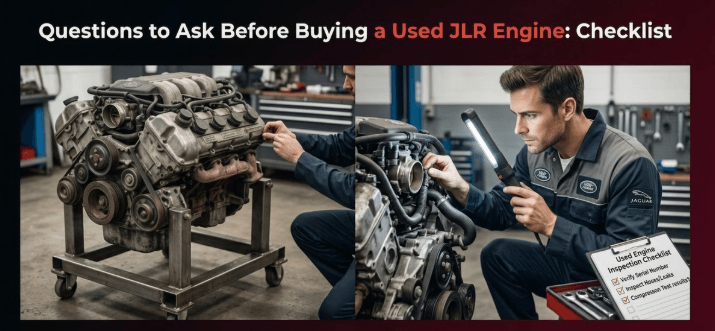
Questions to ask before buying a used JLR engine separate owners who get a reliable unit with an enforceable warranty from those who are paying £3,000 for a used 306DT TDV6 with no enforceable warranty.
The quality, service history and integrity of the supplier of used JLR engines is very variable, ranging from Land Rover Discovery 4, Range Rover Sport L494, Defender L663, Range Rover Evoque, Jaguar XF and Discovery Sport. The questions below and the answers that confirm or disqualify a seller are the essence of a used JLR engine buying guide every JLR owner needs.
Most buying guides tell you what can go wrong. This one will tell you what to ask and exactly what the right answer sounds like.
Why Asking the Right Questions Matters More Than Checking the Price:
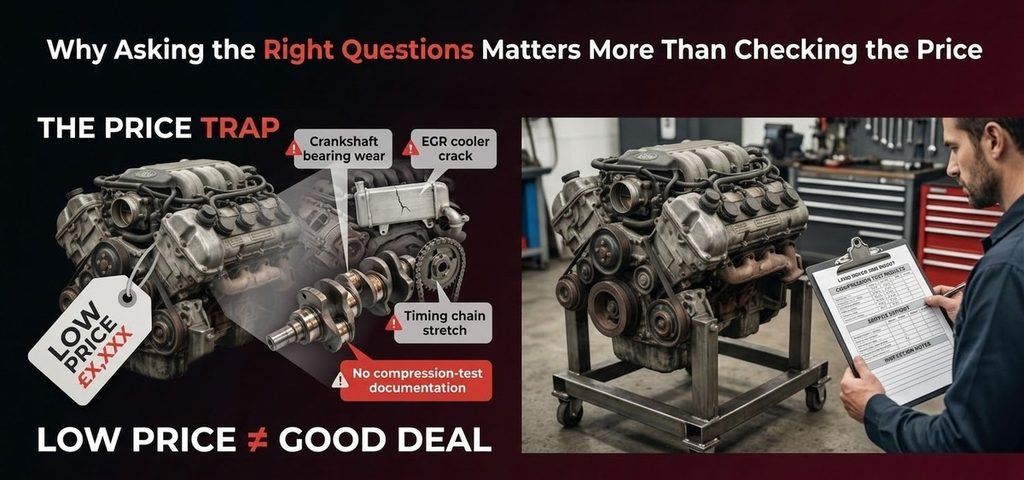
The most common reason owners spend twice when buying used Land Rover engine units is price.
A used 306DT that has no documentation of a compression test is not a bargain; it is a potentially hazardous unknown quantity that could have the same crankshaft bearing wear, EGR (Exhaust Gas Recirculation) cooler crack or timing chain stretch that led to the original failure.
The used JLR engine buying guide principle is straightforward: If the seller has verified the information and is confident in the sale, he or she can provide a clear and written response to each of the following questions.
If the seller is reluctant, deflects or gives verbal assurances rather than paperwork, it’s a sign of the opposite.
The 12 Questions with Right Answers and Red Flags:
| Question | Right Answer | Red Flag |
| What is the exact engine code of this unit? | Immediate, specific: “204DTA,” “306DT,” “30DDTX” | “It’s a 3.0 diesel”: no engine code means no verification |
| Where did this engine come from? | Named UK donor vehicle, known history, accident- not an engine fault | “Trade source,” “overseas import,” “can’t say” |
| What mileage did the donor vehicle have? | Specific figure with supporting documentation | Vague range: “around 70,000–80,000” without paperwork |
| Has a compression test been carried out? | Yes, written report provided, minimum 22 bar, ≤1.5 bar variance | “It runs fine” / “we pressure tested it” without a written report |
| Has an SDD or Pathfinder diagnostic scan been run? | Yes, report showing zero pending fault codes on the engine ECU | “We used an OBD scanner”; OBD-II misses JLR-specific fault codes |
| What oil service interval did the donor vehicle follow? | 10,000 miles or less; confirmed by service history | “Standard manufacturer intervals”: 21,000 miles on an Ingenium diesel accelerates timing chain wear |
| Has the timing chain or timing belt been inspected? | Yes, inspection report, tensioner condition noted | “Engines of this age always have timing issues”: evasion |
| What warranty does this engine carry? | Written warranty, minimum 6 months, naming specific components covered | “30-day warranty” or verbal only |
| Does the warranty cover labour if the engine fails? | Yes, parts and labour both covered | Parts only; leaves owner paying £1,000+ fitment charge on a warranty claim |
| Is there a core exchange surcharge? | Clear yes or no with the surcharge amount stated upfront | Discovered after ordering, often £300–£800 |
| Does the engine number match what will appear on the V5C? | Engine number confirmed and provided in writing before purchase | “You’ll sort that with the DVLA”; puts the admin and risk on the buyer |
| Can I inspect the engine or see it run before purchasing? | Yes, or video evidence of a running test with SDD connected | “We don’t do that”: a supplier confident in their product has nothing to hide |
Used Range Rover engine questions for the TDV6 specifically should add one more: “Has the timing chain tensioner been updated to the current specification?” A 306DT with the old tensioner (LR part LR029351) is a no matter how many miles it has on the clock, a failure waiting to happen.
The right answer is yes, with confirmation of the part number. One absolute disqualifier on the JLR engine seller red flags list is any seller who doesn’t have a written compression test report.
Used Ingenium engine checks add a further question not needed for TDV6 buyers: “Which generation of the 204DT is this unit: 204DTA, 204DTC or 204DTD?” A 204DTA fitted to a 2021 Defender application causes ECU communication failures. The right seller is aware of which generation he’s selling.
The used TDV6 engine buying checklist includes: has the oil pickup pipe and strainer been checked? A blocked pickup pipe is the cause of crankshaft bearing failure on 306DT and 276DT units, and the seller who has inspected and confirmed the condition of the pickup pipe has done the work to prevent further failure.
The 5 Documents Every Used JLR Engine Should Come With:
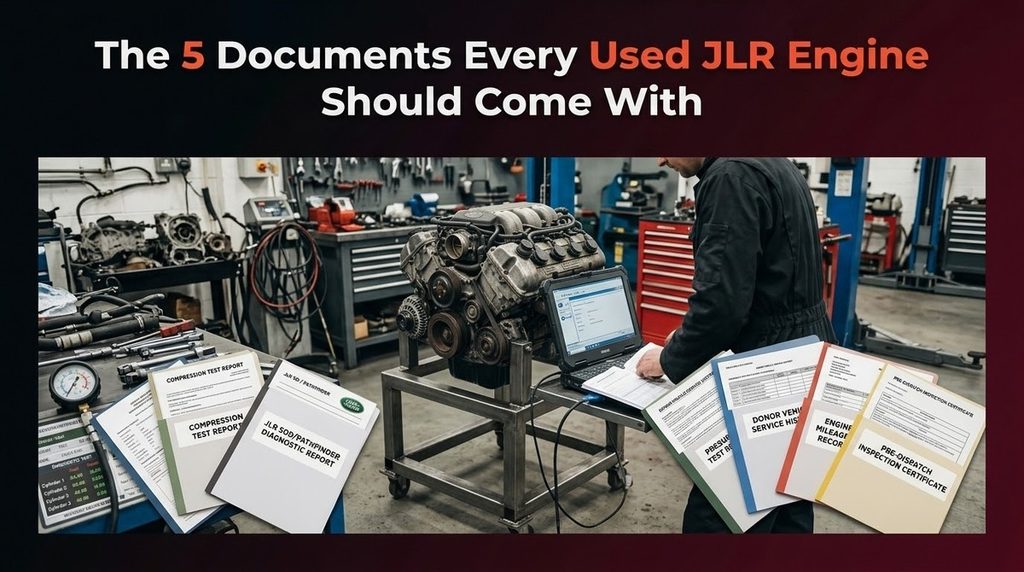
JLR engine SDD diagnostic report and written compression test results are non-negotiable. These 5 documents provide an objective confirmation of the condition of the engine; no seller opinion needed.
| Document | What It Confirms | Red Flag if Missing |
| Written compression test report | All cylinders minimum 22 bar, ≤1.5 bar variance between cylinders | Engine has not been bench-tested internally |
| SDD or Pathfinder diagnostic report | Zero pending ECU fault codes on the engine before dispatch | Seller is relying on generic OBD-II; JLR faults go undetected |
| Donor vehicle service history | Oil change intervals, mileage history, previous faults | Engine mileage and maintenance claims are unverifiable |
| Written warranty document | Specific components covered, duration, labour inclusion | Verbal warranty is unenforceable; seller will dispute claims |
| Engine number in writing | Matches what will be recorded on V5C update with DVLA | Owner faces DVLA complications and potential insurance issues |
The used engine compression test results should be shown on a printout, not verbally as “compression is good. Any reputable used JLR engine supplier will have this documentation, as they have tested the engine before putting it up for sale. A supplier who failed to test the engine, or tested it but doesn’t want you to see the results.
JLR engine SDD diagnostic report is the document that makes the difference between a JLR-specialist supplier and a general engine trader. The software needed to run an SDD scan is not owned by general suppliers and is specific to JLR.
The presence of this indicates that the seller has the tooling and the expertise to accurately evaluate a JLR engine, the lack of which indicates the opposite.
The 10,000-mile service interval, which is designed to stop the Ingenium timing chain from failing and the TDV6 bearings from wearing out, is confirmed by the used engine oil history from the donor car.
A service book with 21,000-mile service intervals for a used 204DTA Ingenium diesel is a known problem: that engine has been running on bad oil for 21,000 miles and has been wearing guides.
JLR engine warranty before buying must be read alongside this history. A supplier with a 12-month warranty on an engine with a 21,000-mile service interval is covering a higher-risk engine than one with a 10,000-mile history.
FAQs:
What are the most crucial questions to ask before purchasing a used JLR engine?
The 3 most important questions to ask before purchasing a used JLR engine are: Can you offer a written compression test report? Has an SDD diagnostic scan been run with zero pending fault codes? What is the warranty for parts and labour? If any supplier cannot clearly answer all 3 questions in writing, then they are to be treated with extreme caution.
What are the red flags for a JLR engine seller?
The following are the most reliable red flags you should look for when choosing a JLR engine seller: They can’t tell you the exact engine code; They don’t have any written compression test documentation; They don’t have a written warranty; They refuse to give you an SDD diagnostic report. All four of them taken together are a clear sign to leave; each one of them taken individually decreases confidence.
What documents should a used Ingenium engine have?
Used Ingenium engine checks need 5 documents: written compression test with cylinder-by-cylinder readings, SDD diagnostic report with no pending faults, donor vehicle service history with 10,000-mile oil change intervals, written warranty stating which components are covered and a written engine number confirmation for DVLA V5C.
How to test a used TDV6 engine?
A used TDV6 engine buying checklist includes: Compression test report (22 bar minimum, variance of ≤1.5 bar), SDD scan with no fault codes, oil pickup pipe inspection report and written warranty for timing chain, crankshaft bearings and head gasket as a minimum.
What is the warranty for a used Land Rover engine?
JLR engine warranty before buying should include labour for warranty work, not just parts, and should include a minimum of 6 months on a used unit and 12 months on a reconditioned unit, naming specific parts such as timing chain, crankshaft bearings, cylinder head gasket, etc.
Conclusion:
Questions to ask before purchasing a used JLR engine protect the purchase before the money changes hands, not after the engine is in the car and a fault arises.
The used JLR engine buying guide rule is that any reputable JLR engine seller who has a genuine, tested and warranted JLR engine to sell should be able to answer all 12 questions clearly and give all 5 documents without hesitation.
If you need to confirm the condition of your used engine, need a Land Rover or Jaguar engine to be rebuilt or repaired, or want an expert opinion on the condition of your used engine or oil history, please contact Jaguar and Land Rover Engine Specialists at jaguarlandroverengines.co.uk or call 02081241303.