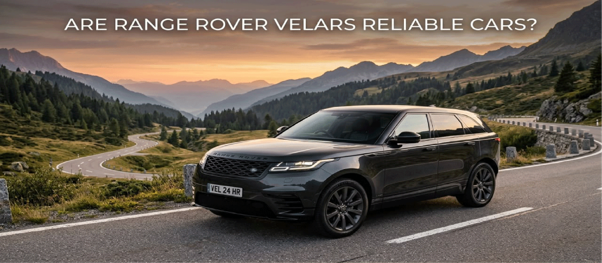
The Range Rover Velar (chassis code L560) is a mid-size luxury SUV. It’s a JLR production from 2017 onwards. Its engine options are the 2.0 Ingenium diesel (204DTA), the 3.0 D300 Ingenium diesel (306DT), the 3.0 P400 Ingenium petrol, and the P400e plug-in hybrid. Depending on the build year and engine, the Range Rover Velar’s reliability changes accordingly.
Now the question is: are Range Rover Velars reliable? And the answer is very simple when broken down by engine and build year. The 3.0 D300 Ingenium diesel (306DT) is a very reliable engine, and owners of the Velar Forums with 40,000–50,000 miles report no major mechanical problems.
In pre-2019 versions, the 2.0 Ingenium diesel (engine code 204DTA) has been known to fail at less than 60,000 miles due to timing chain failures, balance shaft bearing wear, and oil dilution.
The Range Rover Velar was ranked 51st of 76 family SUVs in What Car?’s latest reliability survey with a score of 90.5%, better than the Alfa Romeo Stelvio and Audi Q5, but worse than the Lexus NX. The truth is that Range Rover Velar reliability was much better from 2019 onwards and is almost entirely dependent on the engine under the bonnet.
| Range Rover Velar System | Common Fault | Average UK Repair Cost | Fault Frequency |
| Engine | Timing chain stretch, balance shaft failure | £1,200–£3,800 | High (2.0 diesel pre-2020) |
| Electrical system | Infotainment glitches, warning lights, sensor faults | £200–£900 | High across all years |
| Suspension | Air suspension compressor failure, uneven ride height | £400–£1,500 | Medium above 60,000 miles |
| Braking system | Brake wear, electronic parking brake faults | £150–£600 | Low–medium |
| Fuel system | DPF blockage, fuel injector wear | £600–£2,500 | Medium (urban drivers) |
| Turbocharger | Oil starvation failure, boost pipe split | £800–£2,200 | Medium (2.0 diesel above 80k miles) |
Range Rover Velar Reliability: The Direct Verdict
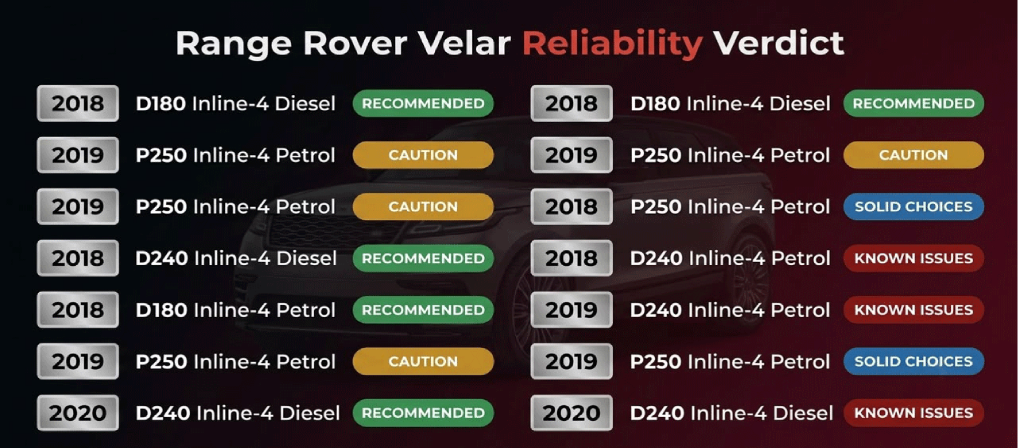
It is not possible to rate the Range Rover Velar reliability as a single rating, as the 2.0 four-cylinder Ingenium and the 3.0 six-cylinder Ingenium are two very different engines with different failure profiles.
| Year | Engine | Reliability Verdict | Primary Risk |
| 2017–2018 | 2.0 Ingenium diesel (204DTA) | Poor; avoid it | Timing chain, balance shaft, oil dilution |
| 2019 | 2.0 Ingenium diesel (204DTA) | Marginal; check service history | Tensioner upgrade, confirm fitment |
| 2020–present | 2.0 Ingenium diesel (204DTA) | Acceptable; needs post-tensioner upgrade | DPF blockage on short journeys |
| 2017–2021 | 3.0 D300 diesel (306DT) | Good | Throttle body clogging, minor EGR |
| 2022–present | 3.0 D300 diesel (306DT) | Good; DVSA recall check required | Cam carrier oil gallery machining recall |
| All years | P400 Ingenium petrol | Good; fewest reported failures | Oil consumption above 50,000 miles |
Pre-2019 Range Rover Velar: The Risky Years
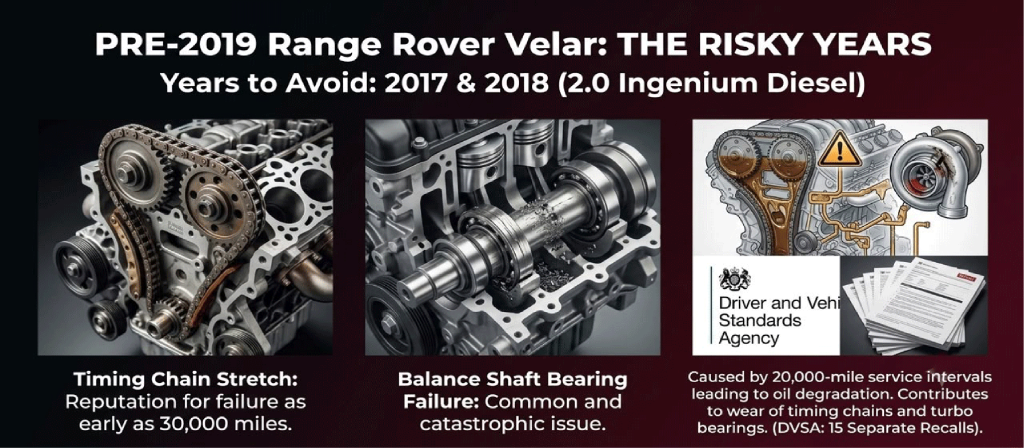
The Range Rover Velar years to avoid are 2017 and 2018 (2.0 Ingenium diesel). This engine model has earned a well-known reputation for timing chain stretch and balance shaft bearing failure, sometimes as early as 30,000 miles.
The reason, as stated by the owners of Velar Forums and by JLR’s technical data, is the 20,000-mile oil service interval for the manufacturer’s 2.0 Ingenium diesel engine, which is too long for the typical driving conditions in the UK.
Oil degradation contributes to the wear of timing chains and to insufficient lubrication of turbocharger bearings. It’s not a one-off occurrence, as the DVSA has issued 15 separate recalls for the Range Rover Velar 2.0 diesel problems, including several for the 2.0 Ingenium engine family.
Post-2019 Range Rover Velar: A Different Picture
The 2017 onwards Range Rover Velar D300 reliability and the 2020 onwards Ingenium reliability are a true improvement in ownership. In late 2019, JLR released an updated timing chain tensioner assembly.
Owners of post-2020 Velars have reported clean ownership experiences on Velar Forums, especially on the D300. The best Range Rover Velar to buy is one that is 2020 or newer, has 10,000 miles on the oil change schedule (not the manufacturer’s 20,000 miles), and has been documented.
Range Rover Velar Common Faults: 5 Problems by Mileage
Range Rover Velar common faults are rather predictable. Each of the following faults has a known solution; it is important to identify each of these faults before they become serious.
- Range Rover Velar Timing Chain Stretch: Metallic rattle on cold start is the main symptom; replacement is £1,200-£1,800, and includes the new tensioner; should be checked at 60,000 miles (96,000 km) minimum on all pre-2020 2.0 diesel Velars.
- Range Rover Velar DPF Issues: It is most often a problem on all Ingenium diesel Range Rover Velars that are driven mainly in urban areas for short distances of less than 10 miles (16 km).
Most DPF failures can be avoided by driving on a motorway at 2,000+ RPM for about 30 miles (48 km) every week; Blocked DPF replacement costs £1,500-£2,500.
- Range Rover Velar Oil Consumption: The oil level should be checked every 1,000 miles. 1-2 litres low will result in failure of turbocharger bearings within hours of running; use only JLR-approved oil specification STJLR.03.5005.
- Piston Cooling Oil Jet Solenoid Failure (204DTA only): Leaking coolant from the thermostat housing damages the piston cooling oil jet solenoid, resulting in piston overheating and increased internal wear; thermostat housing inspection at each service prevents this fault.
- Turbocharger Failure: Occurs on 2.0 Ingenium diesel models over 80,000 miles (128,000 km); symptoms include a gradual increase in a siren-like sound, blue exhaust smoke, and sudden loss of power.
Replacement of a turbo without flushing the oil system will fail within months; fitting a new turbo without flushing the oil system will lead to turbo failure within months.
Which Velar Engine Is More Reliable: 2.0 Diesel or 3.0 D300
The Range Rover Velar Ingenium engine comparison between the 4-cylinder 2.0 and 6-cylinder 3.0 confirms that the 3.0 D300 is by far the more reliable engine.
| Fault | 2.0 Diesel (204DTA) Risk | 3.0 D300 (306DT) Risk | Mileage Threshold |
| Timing chain stretch | High pre-2020 | Low; updated tensioner | 60,000–80,000 miles |
| Balance shaft bearing failure | High (2017–2019) | None reported | Below 60,000 miles |
| Turbocharger failure | High above 80k | Low | 80,000–120,000 miles |
| DPF blockage | High, for urban drivers | Medium | Any mileage, short trips |
| Oil consumption | Medium | Low–medium | 50,000+ miles |
| Throttle body clogging | None | Medium; prevents DPF regen | 60,000+ miles |
The reputation of Range Rover Velar D300 reliability is built on the inline-six engine design, which is now the 3.0 six-cylinder Ingenium, which boasts improved oil management, sturdier internal parts, and the new chain tensioner from the introduction.
The Range Rover Velar 2.0 diesel problems are focused on the 2017-2019 model years and are mostly addressed in 2020 onwards models, but only when serviced at the 10,000-mile oil change interval, not the 20,000-mile interval.
FAQs:
Are Range Rover Velars reliable long-term option?
Yes, if it has the correct engine and build year. With a proven service record and 10,000-mile oil changes, Range Rover Velars 3.0 D300 from 2020 onwards are reliable. Pre-2019 2.0 diesel models have real mechanical issues.
Which is the best Range Rover Velar to purchase?
The best Range Rover Velar to buy is a 2020 or newer D300 3.0 diesel with a full service record of oil changes every 10,000 miles. Do not buy 2017–2018 2.0 diesel models that have not been documented with a timing chain tensioner replacement.
What are the most common Range Rover Velar faults?
The top 5 Range Rover Velar common faults are: timing chain stretch (2.0 diesel), DPF blockage, oil consumption exceeding 50,000 miles, piston cooling solenoid failure, and turbocharger wear due to oil starvation.
What years of the Range Rover Velar should be avoided?
The Range Rover Velar years to avoid are 2017 and 2018 (2.0 Ingenium diesel). These models have the greatest likelihood of a timing chain failure and/or a balance shaft bearing failure, which can happen before 60,000 miles.
Are there similar issues with the Range Rover Velar D300 as with the 2.0?
The 2.0 diesel does not have the same level of reliability as the Range Rover Velar D300. The 2.0 Ingenium four-cylinder has a specific fault pattern with regard to balance shaft bearings and early timing chain stretch, which the 3.0 six-cylinder does not experience.
Conclusion:
If you are wondering, “Are Range Rover Velars reliable options and worth buying?” the answer depends on the car’s engine and build year. With a 3.0 D300 engine or a post-2020 2.0 diesel engine with proper timing chain tensioner work completed and confirmed service history, you have absolutely nothing to worry about.
Oil change discipline is one of the main factors that affect Range Rover Velar reliability. With short intervals of 10,000 miles, most of the documented failures across all Ingenium variants are automatically eliminated. The components in the Range Rover Velar that usually require repair quite often are the Range Rover Velar engine, electrical system, suspension, and fuel system.
A qualified JLR specialist with SDD diagnostic tooling like us can easily assist you with these issues. Contact Jaguar and Land Rover Engine Specialists at 02081241303 for Diagnostic Expertise, Engine Rebuilds and Repairs, or Maintenance and Tune-ups on any Range Rover Velar.