Timing chain failure in JLR engines does not impact all engines in the same way. The 2.0 Ingenium diesel (204DTA) has the highest failure risk, and problems have been reported as early as 60,000 miles.
The 3.0 TDV6 (306DT) is a very predictable failure at 80,000 miles if the tensioner update was not installed. The 3.0 SDV6 (30DDTX) is more durable but will stretch when oil is not changed. The 5.0 AJ133 V8 has the most complicated chain system and the most expensive repair cost if it fails.
JLR timing chain problems are across 4 engine families: Jaguar XE, XF, F-Pace, E-Pace, Land Rover Defender, Discovery Sport, Discovery 4, Range Rover Sport, Evoque, Velar and Vogue, with varying timing of failure, fault codes and repair decisions.
4 JLR Engine Families and Their Timing Chain Risk Profiles:
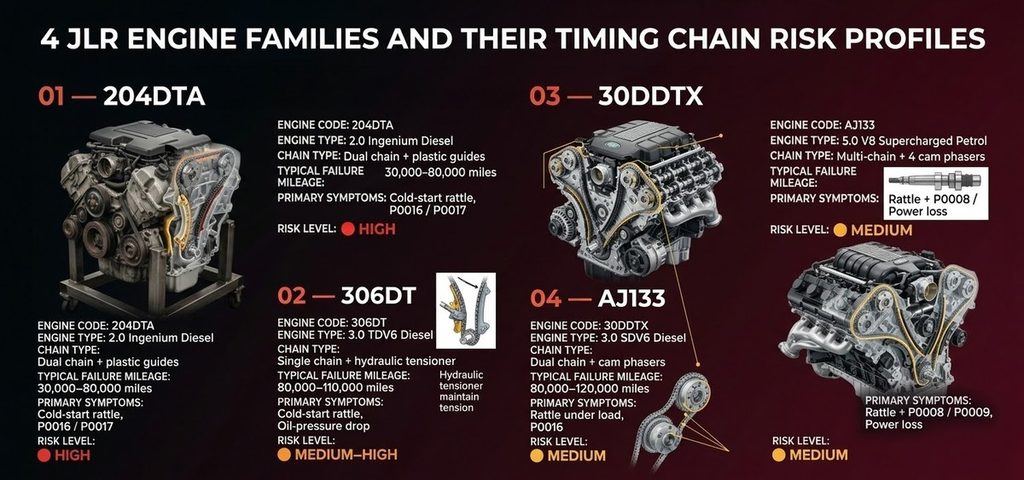
| Engine Code | Engine Type | Chain Type | Typical Failure Mileage | Primary Symptom | Risk Level |
| 204DTA | 2.0 Ingenium Diesel | Dual chain + plastic guides | 30,000–80,000 miles | Cold start rattle, P0016/P0017 | High |
| 306DT | 3.0 TDV6 Diesel | Single chain + hydraulic tensioner | 80,000–110,000 miles | Cold start rattle, oil pressure drop | Medium–High |
| 30DDTX | 3.0 SDV6 Diesel | Dual chain + cam phasers | 90,000–130,000 miles | Rattle under load, P0016 | Medium |
| AJ133 | 5.0 V8 Supercharged Petrol | Multi-chain + 4 cam phasers | 80,000–120,000 miles | Rattle + P0008/P0009, power loss | High; high cost |
The highest risk is 2.0 Ingenium Diesel (204DTA).
Ingenium timing chain failure is the most common timing chain failure in JLR engines. All Jaguar XE, XF, E-Pace, F-Pace, Range Rover Evoque and Velar, and all Land Rover Discovery Sport and Defender L663 models with the 204DTA feature the same dual-chain system with plastic guides that wear out more quickly than the chains.
Oil dilution due to incomplete DPF (Diesel Particulate Filter) regeneration cycles reduces the oil’s viscosity to lubricate the guides, causing wear at a rate that can lead to an audible rattle before 40,000 miles for vehicles that are driven mainly for short urban trips.
The 3.0 TDV6 (306DT) has a risk depending on service history.
TDV6 timing chain failure is predictable and preventable. The 306DT single hydraulic tensioner is prone to failure if the oil pressure is affected by poor oil quality, late oil changes or the original specification for the tensioner, which Land Rover changed through Technical Service Bulletin LTB00493.
Owners of Discovery 4, Range Rover Sport L494 and Discovery 5 who can confirm that the new tensioner (LR part LR029351) has been fitted are at a much reduced risk. Without warning, those who can’t confirm it could cause a chain failure from 80,000 miles (128,000 km) away.
The SDV6 (30DDTX) has moderate risk and hence is often overlooked.
The SDV6 timing chain is not as well known as the 204DTA but has its own failure characteristics. The 30DDTX features a dual-chain design with VVT (Variable Valve Timing) cam phasers that are 100% oil pressure dependent.
The first SDV6 timing chain rattle on the Range Rover Sport L494, Range Rover Vogue L405 and Range Rover Discovery 4 SDV6 is likely to occur between 90,000 and 130,000 miles, which is significantly later than the Ingenium diesel, but still within the average UK ownership mileage.
The symptom that distinguishes SDV6 phaser wear from chain stretch is a phaser rattle under light throttle that disappears under heavy throttle.
5.0 AJ133 V8: Complex Chain System, High Repair Cost
By far the most costly timing chain failure in JLR engines is 5.0 V8 timing chain failure. The AJ133 supercharged V8 has 4 camshafts with individual cam phasers, driven by primary and secondary chains.
The V8 Cam phaser failure JLR is a fluttering sound under light throttle between 1,000 and 2,000 RPM, which is different from the Ingenium cold start rattle.
Unlike Ingenium and TDV6 failures, where Cam phaser failure is usually accompanied by P0016 and P0017, the pair of P0008 and P0009 is more commonly found with Cam phaser failure.
What The Diagnostic Scanner Tells You About the JLR Timing Chain Fault Codes:
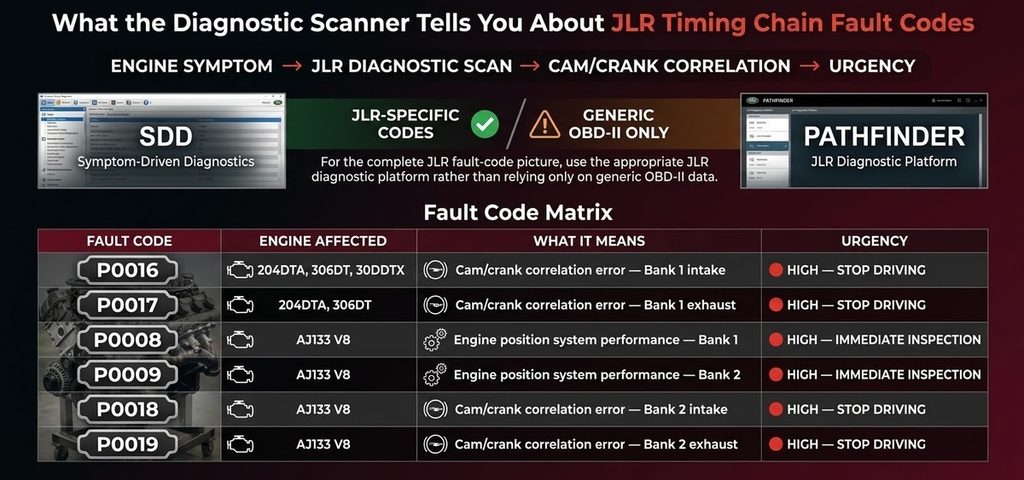
JLR timing chain fault codes confirm what the rattle indicates, but only when the diagnostic tool displays JLR fault codes and not generic OBD-II codes.
To get the complete picture of the fault code on all JLR platforms, SDD (Symptom-Driven Diagnostics) or Pathfinder software is needed.
| Fault Code | Engine Affected | What It Means | Urgency |
| P0016 | 204DTA, 306DT, 30DDTX | Cam/crank correlation error; Bank 1 intake | High, stop driving |
| P0017 | 204DTA, 306DT | Cam/crank correlation error; Bank 1 exhaust | High, stop driving |
| P0008 | AJ133 V8 | Engine position system performance; Bank 1 | High, immediate inspection |
| P0009 | AJ133 V8 | Engine position system performance; Bank 2 | High, immediate inspection |
| P0018 | AJ133 V8 | Cam/crank correlation error; Bank 2 intake | High, stop driving |
| P0019 | AJ133 V8 | Cam/crank correlation error; Bank 2 exhaust | High, stop driving |
These fault codes are always preceded by JLR engine cold start rattle, but in some cases, codes may occur before the rattle is noticeable, especially on SDV6 and V8 engines where other drivetrain noises can mask the chain rattle.
If a JLR engine cold start rattle clears in 5 seconds or less after the engine is started, then a diagnostic scan should be performed within 2 weeks. If the rattle lasts more than 10 seconds, stop the engine and arrange for recovery.
Why Timing Chain Failure Happens In Each JLR Engine:
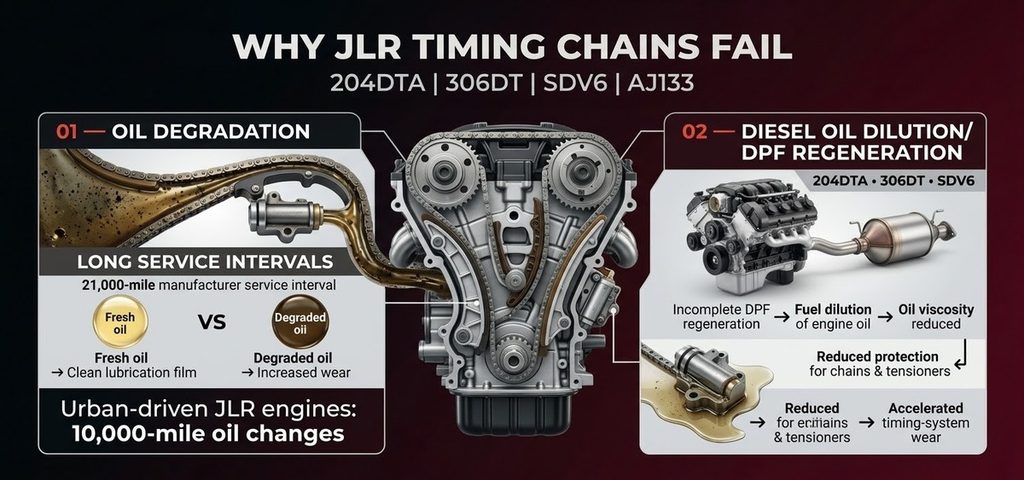
While there are differences between the 204DTA, 306DT, SDV6 and AJ133, JLR timing chain problems have 4 root causes that affect all of JLR’s engine lineup:
- Oil degradation due to long service intervals: JLR’s 21,000-mile oil change is for optimum motorway driving; most UK owners drive a combination of urban and mixed driving conditions, which reduces the life of the oil; 10,000-mile oil changes are the correct interval for any JLR engine driven in urban conditions.
- Oil dilution due to failure of DPF regeneration: Only applies to diesel engines (204DTA, 306DT, SDV6); if the DPF is not regenerated on a long enough journey, then the oil becomes too thin to lubricate the chains and tensioners, and this will cause failure of the DPF regeneration.
- The use of semi-synthetic or non-approved oil grade accelerates guide and tensioner wear, even at extended service intervals, and is not acceptable for any of the four engine families; JLR-approved oil STJLR.03.5005 fully synthetic is required.
- The cost of repairing the rattle stage of the cold start is £1,500 – £2,500, while the post-failure stage is £5,000 – £15,000, and each week of driving on a rattling chain reduces the time between chain repair and engine rebuild.
Timing Chain Replacement Cost UK by Engine Family:
The timing chain replacement cost UK ranges from 4 times the cheapest to the most expensive engine families.
| Engine | Chain Replacement Cost | Rebuild Cost if Chain Fails | Typical Lead Time |
| 204DTA Ingenium | £1,500–£2,200 | £5,000–£10,000 | 2–4 days |
| 306DT TDV6 | £1,800–£2,800 | £4,500–£8,000 | 3–5 days |
| 30DDTX SDV6 | £2,000–£3,500 | £5,500–£10,000 | 3–6 days |
| AJ133 5.0 V8 | £3,500–£6,000 | £8,000–£15,000+ | 5–8 days |
The multi-chain arrangement and access to the 4-phaser system for JLR engine timing chain repair add to the cost of the repair compared to the 204DTA or 306DT.
The 204DTA’s engine access is easier, and the parts for the timing chain kit are readily available, which is why JLR engine timing chain repair is the cheapest.
FAQs:
Which JLR engine has the worst timing chain failure problem?
The 2.0 Ingenium diesel (204DTA) has the highest failure rate. The Ingenium timing chain is the most susceptible engine in the JLR lineup, failing as early as 30,000-40,000 miles on vehicles that are driven in urban conditions with long oil change intervals.
Is there a warning for TDV6 timing chain failure?
No, a timing chain failure on TDV6 will always result in a cold start rattle prior to catastrophic failure. The rattle is seen weeks or months before the chain jumps. In most cases, owners who treat the rattle stage will prevent damage to their engines.
What are the fault codes for SDV6 timing chain issues?
The main code for SDV6 timing chain cam-to-crank correlation failure is P0016. In some instances, phaser-specific faults are logged with it. The full SDV6 fault picture can only be read using SDD or Pathfinder diagnostics, and not a generic OBD-II reader.
Is the 5.0 V8 timing chain worse than the Ingenium?
The 5.0 V8 timing chain system is more complicated and more costly to repair, but it is less likely to fail at low mileage than the 204DTA. The V8 will last 80,000-100,000 miles without chain or phaser problems, while the 204DTA can fail before 50,000 miles.
Is it possible to avoid timing chain failure in JLR engines?
Yes, 10,000-mile oil change intervals with STJLR.03.5005 fully synthetic oil, weekly 30-mile motorway drives on diesel models, and immediate action on any JLR engine cold start rattle prevent the majority of JLR timing chain issues across all 4 engine families.
Conclusion:
The timing chain failure in JLR engines can be predicted and, in most instances, prevented at the cold start rattle stage before internal damage has occurred.
The 204DTA Ingenium, TDV6 timing chain failure, SDV6 or 5.0 V8; all of these failures are caused by the same 4 root causes, and all of these failures can be prevented by early intervention.
To confirm JLR timing chain fault codes, for Engine Rebuilds and Repairs for all 4 engine families and for Maintenance and Tune-ups to keep chains healthy, please contact Jaguar and Land Rover Engine Specialists at jaguarlandroverengines.co.uk or call 02081241303.