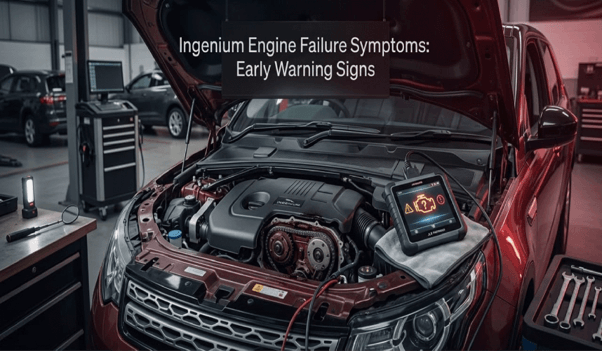
Ingenium engine failure symptoms appear in a predictable sequence: cold start rattle first, then power loss, oil dilution warnings, limp mode and finally catastrophic internal damage if the chain or turbocharger fails completely.
The 2.0 Ingenium diesel (engine code 204DTA) is the most commonly affected unit, fitted across the Land Rover Discovery Sport, Land Rover Defender, Range Rover Evoque, Range Rover Velar, Jaguar XE, Jaguar XF, Jaguar E-Pace and Jaguar F-Pace.
Catching Ingenium engine failure symptoms before the mid-stage saves owners between £3,000 and £15,000 in repair costs.
Which Vehicles Have the Ingenium Engine?
Ingenium engine problems affect every JLR (Jaguar Land Rover) model produced since 2015 using the 2.0 four-cylinder diesel (204DTA), 2.0 four-cylinder petrol (204PT) or 3.0 six-cylinder diesel/petrol Ingenium units.
The 2.0 Ingenium diesel problems are the most widely documented because the 204DTA is the highest-volume engine in the range.
| Model | Engine Code | Fuel | Years Affected |
| Land Rover Discovery Sport | 204DTA | Diesel | 2015–present |
| Land Rover Defender (L663) | 204DTA / 204DTD | Diesel | 2020–present |
| Range Rover Evoque (L551) | 204DTA | Diesel | 2019–present |
| Range Rover Velar (L560) | 204DTA | Diesel | 2017–present |
| Range Rover Sport (L461) | 204DTA | Diesel | 2023–present |
| Jaguar XE | 204DTA | Diesel | 2015–present |
| Jaguar XF (X260) | 204DTA | Diesel | 2015–present |
| Jaguar E-Pace | 204DTA | Diesel | 2017–present |
| Jaguar F-Pace | 204DTA | Diesel | 2016–present |
The 8 Ingenium Engine Failure Symptoms in Order of Appearance:
Ingenium engine failure symptoms follow a timeline.
The earliest symptoms are subtle: a brief rattle, a premature service warning, while late-stage symptoms are unmistakable. Catching the fault in the first 3 symptoms prevents the last 5.
| Symptom | Stage | Mileage Threshold | Urgency |
| Cold start metallic rattle | Early | 30,000–60,000 miles | Book diagnostic within 2 weeks |
| Premature service light | Early | 10,000–20,000 miles | Shorten oil change interval immediately |
| Increased oil level on dipstick | Early | Any mileage | Oil dilution; check immediately |
| DPF warning light | Early-mid | 30,000–80,000 miles | Regeneration failure; address within days |
| Power loss under load | Mid | 50,000–100,000 miles | Turbo or chain; SDD diagnostic required |
| Limp mode activation | Mid | 60,000–100,000 miles | Stop driving; diagnostic before restarting |
| Blue/white exhaust smoke | Late | 80,000–120,000 miles | Turbo or head gasket; engine at risk |
| Engine knock or bang | Late | Any mileage post chain failure | Stop engine immediately; full assessment |
Early Stage Symptoms (0–60,000 miles):
Ingenium engine cold start rattle is the most important early symptom. On a 204DTA engine at operating temperature, the timing chains run quietly within ±25 RPM idle stability.
A metallic rattle audible for 3–10 seconds after a cold start, disappearing once oil pressure builds, is the timing chain guides beginning to wear. The Ingenium engine cold start rattle must never be dismissed as “normal warm-up noise.”
At this stage the repair is a timing chain replacement at approximately £1,500–£2,000; left until the chain jumps, the repair is a full engine replacement.
Ingenium engine oil dilution is the second early symptom. JLR’s own Service Compliance Notification JLRP00100 acknowledges that diesel fuel entering the oil during incomplete DPF (Diesel Particulate Filter) regeneration cycles can cause oil dilution above 6.1%, triggering a service warning before the standard 21,000-mile interval.
If the oil level on the dipstick is rising between services rather than falling, the engine oil is being diluted with diesel fuel. Ingenium engine oil dilution accelerates timing chain wear and turbocharger bearing damage, both faults that appear within 10,000 miles of the dilution being ignored.
Ingenium DPF problems appear early on vehicles used predominantly on short urban journeys under 10 miles (16 km). The 204DTA DPF requires a sustained motorway drive at 2,000+ RPM for 20–30 minutes to complete a passive regeneration cycle.
Without this, the DPF warning illuminates and forced regeneration injects additional fuel into the cylinder, worsening Ingenium DPF problems and accelerating oil dilution simultaneously.
Mid Stage Symptoms (60,000–100,000 miles):
Ingenium engine limp mode activates when the ECU (Engine Control Unit) detects a fault severe enough to limit engine output to approximately 30% of normal power.
On Ingenium diesel models, Ingenium engine limp mode is triggered by turbocharger boost pressure loss, DPF overpressure, VVT (Variable Valve Timing) solenoid failure or timing chain misalignment. Driving in limp mode compounds internal damage; a vehicle in limp mode requires SDD (Symptom-Driven Diagnostics) before further use.
Ingenium turbocharger failure in mid-stage presents as blue smoke from the exhaust under acceleration, loss of power above 2,000 RPM and a rising whine from the engine bay.
On the 204DTA, Ingenium turbocharger failure is almost always oil-related, either oil starvation from diluted oil starving the turbo bearings, or oil contamination from plastic timing chain guide debris blocking the turbo feed line.
Turbocharger replacement on a 204DTA runs £1,500–£3,000; if the debris has entered the engine, a full rebuild is required.
Late Stage Symptoms (100,000+ miles):
Blue or white exhaust smoke sustained beyond cold start, an audible knock from the engine bay under load or a sudden loss of all power indicate late-stage failure. At this point the timing chain has either jumped or snapped, or the crankshaft bearings have begun to fail.
An Ingenium engine rebuild is the only viable route when the chain has jumped; the damage to pistons, valves and cylinder head requires a full strip and assessment before any cost can be confirmed.
A second Ingenium engine rebuild scenario involves turbocharger debris entering the sump, damaging crankshaft bearings and requiring a complete engine teardown.
What Causes Ingenium Engine Failure: The 3 Root Causes
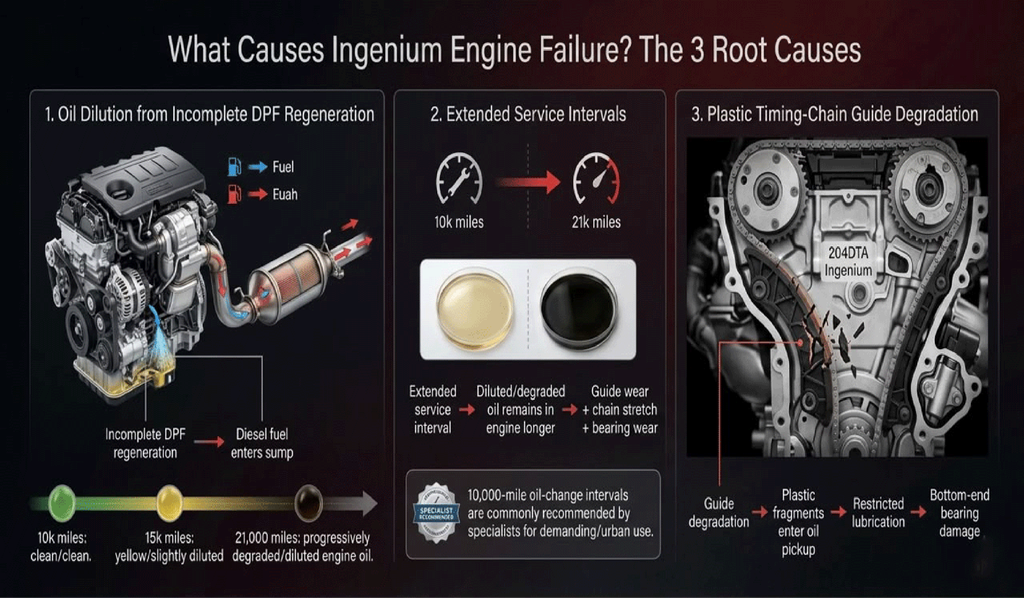
2.0 Ingenium diesel problems trace back to 3 interconnected root causes rather than isolated component failures:
- Oil dilution from incomplete DPF regeneration: Diesel fuel enters the sump during failed regeneration cycles, thinning the oil below the viscosity required to lubricate timing chain guides and turbocharger bearings; this is the primary root cause of both timing chain and turbo failures.
- Extended oil service intervals: The manufacturer’s 21,000-mile oil service interval was designed for ideal driving conditions that most UK urban drivers never experience; diluted oil left in the engine for 21,000 miles causes guide wear, chain stretch and bearing damage that 10,000-mile intervals prevent.
- Plastic timing chain guide degradation: The chain guides on the 204DTA degrade faster than the chains themselves; broken plastic fragments enter the oil pickup, blocking lubrication to the bottom end and triggering secondary bearing and crankshaft damage.
What to Do When You Spot Ingenium Engine Failure Symptoms?
2.0 Ingenium timing chain replacement cost at a JLR specialist runs £1,500–£2,000 for a complete replacement of both chains, all guides, tensioners, the VVT solenoid and an oil and filter change.
This cost is the early intervention price. Waiting until the chain jumps increases the total to £5,000–£15,000 for engine assessment and replacement.
The 2.0 Ingenium timing chain replacement cost is best treated as preventative at 60,000 miles (96,000 km) regardless of symptoms, particularly for Discovery Sport and Jaguar XF owners with a known urban driving history.
For any Ingenium model showing the early symptoms in this guide, an SDD diagnostic scan confirms the fault before any work is authorised.
An Ingenium engine rebuild becomes necessary only when the chain has caused valve or piston damage; the diagnostic scan at the cold-start-rattle stage prevents this outcome in most cases.
FAQs:
What are the first Ingenium engine failure symptoms?
The first Ingenium engine failure symptoms are a metallic cold-start rattle lasting 3–10 seconds and a premature service warning caused by Ingenium engine oil dilution. Both appear before 60,000 miles on most affected 204DTA units.
Which Ingenium engine problems are most common?
Ingenium engine problems in order of frequency: timing chain stretch (most common), oil dilution causing premature service warnings, DPF blockage and turbocharger failure. All 4 are linked to oil quality and service interval.
Does Ingenium timing chain failure cause limp mode?
Yes, Ingenium timing chain symptoms in mid-stage include limp mode activation when the ECU detects VVT solenoid failure or timing misalignment caused by chain stretch. Ingenium engine limp mode requires an SDD diagnostic before the vehicle is driven further.
How much does Ingenium timing chain replacement cost?
2.0 Ingenium timing chain replacement cost at a JLR specialist is £1,500–£2,000 complete both chains, all guides, tensioners, VVT solenoid and oil change. Waiting until the chain fails raises this to £5,000–£15,000.
Can Ingenium DPF problems cause engine damage?
Yes, Ingenium DPF problems cause oil dilution when regeneration cycles fail, which directly accelerates timing chain guide wear and turbocharger bearing failure on 204DTA units used on short journeys.
Conclusion:
Recognising Ingenium engine failure symptoms at the cold start rattle stage before oil dilution, limp mode or Ingenium turbocharger failure develops saves thousands of pounds and prevents the need for a full Ingenium engine rebuild.
For Diagnostic Expertise using SDD tooling, Engine Rebuilds and Repairs and Maintenance and Tune-ups across all Ingenium-engined Land Rover, Range Rover and Jaguar models, contact Jaguar and Land Rover Engine Specialists at jaguarlandroverengines.co.uk or call 02081241303.


