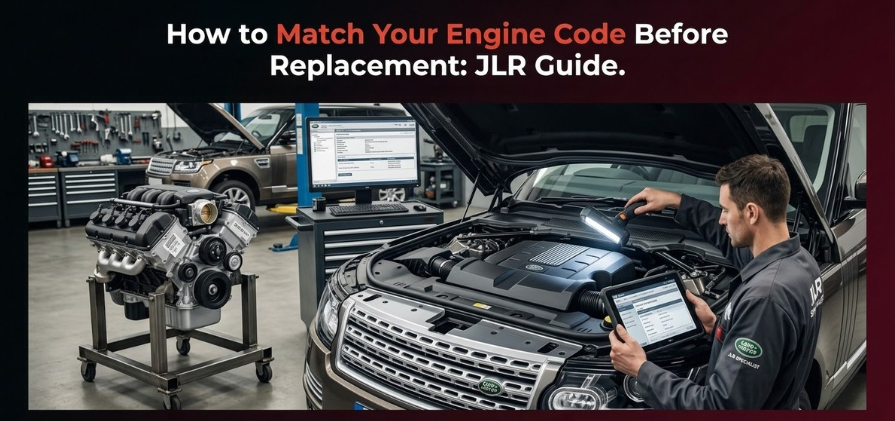
The process of learning how to match your engine code before replacement is more complex on Land Rover and Range Rover vehicles than on most other vehicles. The answer is simple: the same engine size is used in several generations of JLR engines.
A 2.0-litre diesel in a 2015 Discovery Sport (engine code 204DTA) is not interchangeable with a 2.0-litre diesel in a 2020 Defender (engine code 204DTD), although they are both 2.0-litre Ingenium diesel engines.
The chassis code, engine generation and ECU (Engine Control Unit) software version are all critical to the fitment of the engine, and if the wrong one is fitted, the ECU will fail to map, Terrain Response will fail, and a DVLA V5C notification issue may occur immediately.
This guide takes you through each step that a Land Rover, Range Rover or Jaguar owner has to take before ordering any replacement engine.
Step 1: Find the Engine Code Plate on Your Land Rover or Range Rover
The Range Rover engine code location and Land Rover engine code plate position vary from model to model and generation to generation. The engine code is never simply on the engine, but stamped and plated in certain areas that differ from platform to platform.
| Model | Primary Code Plate Location | Secondary Location | Stamp Location |
| Range Rover Sport L320 | Engine top cover sticker | Door jamb VIN plate, position 7 | Block near dipstick tube |
| Range Rover Sport L494 | Engine top cover label | V5C Section D.2 | Block front face, passenger side |
| Range Rover Vogue L405 | Under-bonnet sticker, firewall | V5C Section D.2 | Block front, near coolant housing |
| Land Rover Defender L663 | Engine top cover | V5C and SDD scan | Block rear, below camshaft cover |
| Land Rover Discovery 4 | Engine bay label, passenger side | V5C Section D.2 | Block front near oil filter housing |
| Land Rover Discovery Sport | Top engine cover label | V5C and SDD scan | Block front face |
| Range Rover Evoque L551 | Top cover sticker | V5C Section D.2 | Block near HPFP mount |
The engine code on the plate is a 5–7 character alphanumeric code: 204DTA, 306DT, 30DDTX, 276DT, 508PN.
The engine number is a longer serial number that is stamped on the block itself. The engine code is used to identify the engine family and specification; the engine number is used to identify the individual engine for DVLA registration purposes.
Both are required for engine code matching Land Rover; the engine code determines compatibility, and the engine number determines V5C documentation.
Step 2: Understand the meaning of the Engine Code
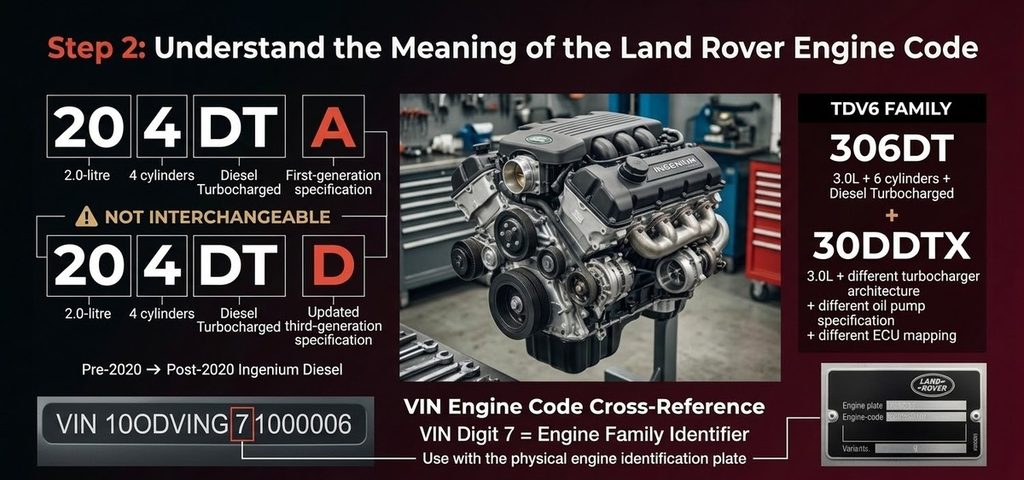
Land Rover engine code guide reading is straightforward once the logic is understood. JLR engine codes are consistent and provide you with information about the engine’s displacement, fuel type and specification generation.
The 204DTA is broken down as 20 (2.0-litre) + 4 (four cylinders) + DT (diesel turbocharged) + A (first generation specification). 204DTD is the same, with D representing the updated third-generation specification. They are not interchangeable, as this is just a single-letter difference between the pre-2020 and post-2020 Ingenium diesel.
The TDV6 family: 306DT = 30 (3.0-litre) + 6 (six cylinders) + DT (diesel turbocharged). The new 30DDTX variant is the same displacement, but with a different turbocharger architecture, different oil pump specification and different ECU mapping requirements.
VIN engine code Land Rover cross reference: For all JLR vehicles manufactured since 2010, the engine variant code is VIN digit 7. This is not the entire engine code, but a one-character identifier for the engine family which verifies the displacement category. This must be used in conjunction with the physical plate, and the VIN digit will verify that you are drilling into the correct code variant of the engine family.
Step 3: Cross-Reference Chassis Code with Engine Code
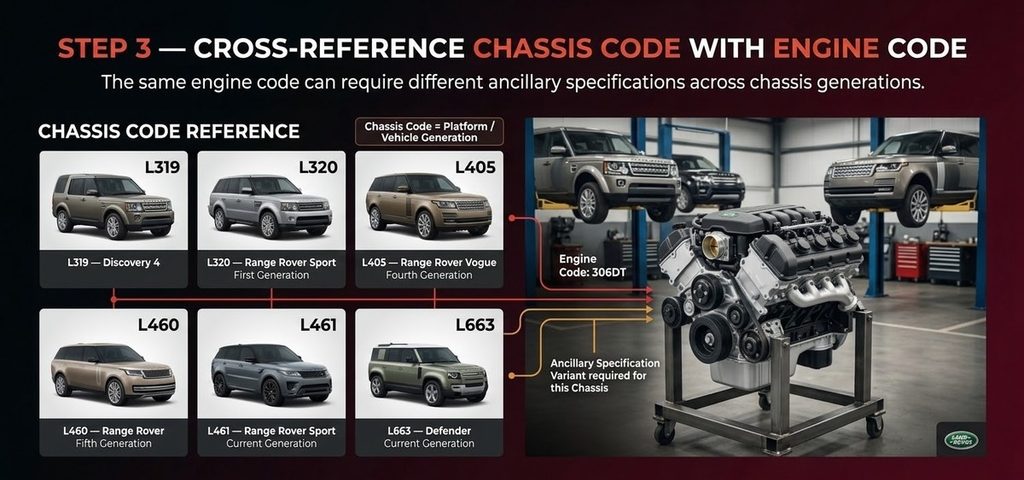
Land Rover chassis code check is the most overlooked compatibility check by owners and even some workshops, and it results in the most expensive compatibility failures.
The chassis code is the designation of the platform: L319 (Discovery 4), L320 (Range Rover Sport first generation), L405 (Range Rover Vogue fourth generation), L460 (Range Rover fifth generation), L461 (Range Rover Sport current generation), L663 (Defender current generation).
The reason that the JLR engine compatibility check by chassis code is important is that the same engine code was used in various generations of chassis. But the wiring harness connectors, engine mount positions, coolant circuit routing and ECU software versions were not the same.
A Land Rover chassis code check confirms which ancillary specification the replacement engine must carry.
The most frequent compatibility problem with chassis codes is installing a 306DT into an L494 Range Rover Sport. The 306DT is used in both vehicles, but the L494 is a later electronic throttle body specification and EGR (Exhaust Gas Recirculation) circuit routing.
The engine physically fits, but the ECU is not able to communicate with the throttle control on the replacement unit.
Step 4: Check Engine Generation Compatibility
The most technically demanding test for any post-2015 JLR car is Ingenium engine generation compatibility. The 2.0 Ingenium diesel family includes 3 generations (204DTA 2015-2018, 204DTC 2018-2020, 204DTD 2020-present) with different ECU software, injector specifications and emissions calibrations.
Engine code matching Land Rover across generations requires confirming not just the code but the build date of the donor engine. The 204DTA is a 2016 Discovery Sport that has been installed in a 2021 Defender, and this combination causes ECU mismatch errors due to the body control module in the Defender using 204DTD-specification communication protocols.
Standard OBD-II scanners will not read the requirements for JLR generation-specific module communication; only SDD (Symptom-Driven Diagnostics) or Pathfinder software can do that.
Land Rover engine code guide users should also be aware that from 2017, JLR started to use the MHEV (Mild Hybrid Electric Vehicle) 48-volt belt-integrated starter generator on some Ingenium petrol models, which have different engine code suffixes and a different electrical interface than non-MHEV models.
When a non-MHEV Ingenium is fitted into an MHEV Discovery Sport or Range Rover Velar, the mild-hybrid system is deactivated, and the ECU will show persistent faults.
Step 5: Check V5C and Check DVLA Requirements
The DVLA engine number change notification is a legal requirement when the replacement engine has a different engine number to that on the V5C logbook. The new engine number, engine size and fuel type are sent to the DVLA on a V5C green slip or online notification (section 7) of the V5C.
Any reputable specialist will confirm Range Rover replacement engine compatibility with the V5C before supplying the engine; the engine code on the replacement unit should be the same as the engine code in Section D.2 of the V5C (which records the original engine family).
This is a major modification to the vehicle, as the replacement engine may be a different code from the original (e.g. a 30DDTX fitted into a vehicle previously registered with a 306DT), and will need to be notified to the DVLA, disclosed to the insurance company and may need an MOT test if the power output is different.
The second DVLA engine number change consideration: Rebuilding the original engine block does not require a DVLA update and retains the original engine number. That’s one of the reasons that JLR owners with blocks that are structurally sound may opt for a rebuild rather than replacement, as there is no paperwork involved in the V5C.
Common JLR Engine Code Mismatches and What Happens When You Get It Wrong:
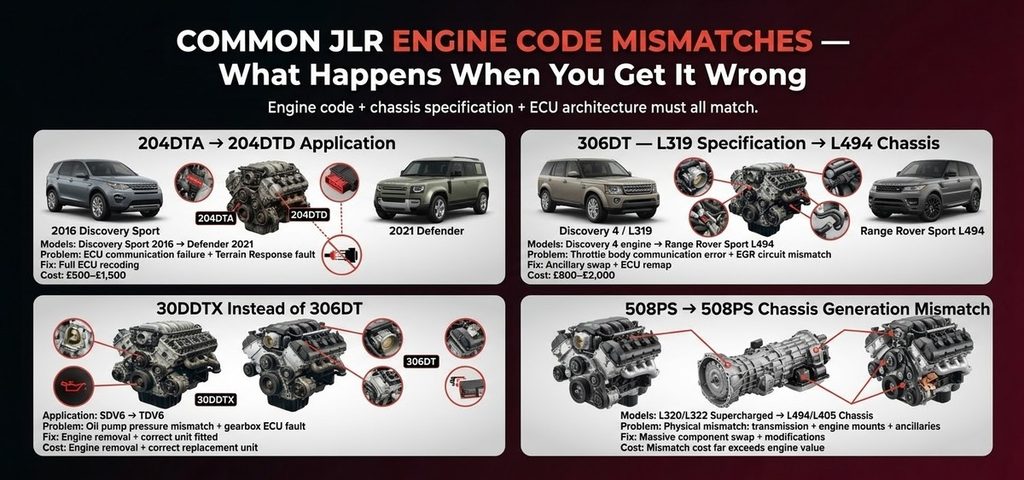
| Mismatch | Models Involved | What Goes Wrong | Cost to Fix |
| 204DTA fitted to 204DTD application | Discovery Sport 2016 into Defender 2021 | ECU communication failure, Terrain Response fault | Full ECU recoding + £500–£1,500 |
| 306DT (L319 spec) into L494 chassis | Discovery 4 engine into Range Rover Sport L494 | Throttle body communication error, EGR circuit mismatch | Ancillary swap + ECU remap £800–£2,000 |
| 30DDTX instead of 306DT | SDV6 into TDV6 application | Oil pump pressure mismatch, gearbox ECU fault | Engine removal + correct unit fitted |
| MHEV Ingenium into non-MHEV vehicle | Velar MHEV engine into non-MHEV Evoque | 48V system fault, persistent warning lights | ECU replacement + £1,200–£2,500 |
JLR engine compatibility check errors are not easy to see at installation; many are only apparent when the engine is under load, during DPF regeneration or when the gearbox ECU asks for torque data that the mismatched engine cannot provide.
The above Range Rover replacement engine compatibility table is for the 4 most common errors that JLR owners make when ordering replacement engines without checking the full engine code and chassis code compatibility.
FAQs:
What is the procedure to match my engine code before replacement on a Range Rover?
To match your engine code before replacement on a Range Rover: find the engine code plate under the bonnet, cross-reference with VIN digit 7, confirm chassis code (L320, L405, L460), confirm engine generation (204DTA vs 204DTD), then check Section D.2 of the V5C before ordering.
Where is the engine code plate on a Land Rover Discovery 4?
A Discovery 4 Land Rover engine code plate is located on the sticker on the passenger side of the engine compartment and is also found on the V5C Section D.2. The engine number is located on the block close to the oil filter housing.
What does the VIN engine code mean on a Land Rover?
VIN engine code for a Land Rover is the single character at VIN digit position 7 that is used to identify the engine displacement family. This is to verify the engine type but must be used in conjunction with the physical engine code plate to verify full compatibility.
Is it necessary to notify DVLA when replacing the engine in a Land Rover?
Yes, a DVLA engine number change notification must be made if the replacement engine has a different engine number to that on the V5C. This is not necessary when rebuilding the original block.
What’s the most frequent engine code matching error?
The most frequent engine code matching Land Rover error is ordering by engine size only, such as “2.0 diesel” without specifying 204DTA vs 204DTD generation. This leads to ECU communication failure, which necessitates extra coding or an engine re-swap.
Conclusion:
A registration plate check is not enough to match your engine code before replacement on a Land Rover or Range Rover.
How to match your engine code before replacement on a Land Rover or Range Rover requires 5 verified steps, namely: code plate, VIN digit, chassis code, engine generation and V5C confirmation.
JLR engine compatibility check errors discovered after installation cost more to correct than the original engine. To confirm engine code compatibility for Diagnostic Expertise, or to carry out an Engine Rebuild or Repair for all JLR engine codes, or to support Land Rover engine codes before replacement, please contact Jaguar and Land Rover Engine Specialists at jaguarlandroverengines.co.uk or call 02081241303.


